Ch. 6 - Applications of Integration
Briggs - Calculus: Early Transcendentals 3rd Edition
Briggs3rd EditionCalculus: Early TranscendentalsISBN: 9780136847243Non è quello che usi tu?Cambia libro di testo
Capitolo 6, Problema 6.1.16b

13–16. Displacement from velocity Consider an object moving along a line with the given velocity v. Assume time t is measured in seconds and velocities have units of m/s.


b. Find the displacement over the given interval. 


v(t) = 50e^−2t on [0, 4]

Guida verificata passo dopo passo
1
Identify the displacement as the definite integral of the velocity function over the given time interval. Displacement is given by \(\int_{a}^{b} v(t) \, dt\), where \(a=0\) and \(b=4\) in this problem.
Write down the integral to find displacement: \(\int_{0}^{4} 50 e^{-2t} \, dt\).
Recall the integral formula for an exponential function: \(\int e^{kt} \, dt = \frac{1}{k} e^{kt} + C\). Here, \(k = -2\).
Apply the integral formula to \(50 e^{-2t}\): the antiderivative is \(50 \times \frac{1}{-2} e^{-2t} = -25 e^{-2t}\).
Evaluate the definite integral by substituting the limits: calculate \([-25 e^{-2t}]\) from \(t=0\) to \(t=4\), which means computing \(-25 e^{-8} - (-25 e^{0})\).

Risposta video verificata per un problema simile:

Questa soluzione video è stata consigliata dai nostri tutor come utile per risolvere questo problema.
Durata del video:
2m

Concetti chiave

Ecco i concetti essenziali che devi comprendere per rispondere correttamente alla domanda.

Displacement and Velocity Relationship

Displacement represents the change in position of an object and is found by integrating the velocity function over a given time interval. Since velocity is the rate of change of position, integrating velocity with respect to time gives the net displacement.
Video consigliato:
Percorso guidato
06:29
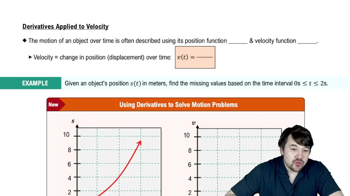
Derivatives Applied To Velocity

Definite Integral

A definite integral calculates the accumulated quantity, such as displacement, over a specific interval. For velocity functions, the definite integral from time a to b gives the total displacement between those times.
Video consigliato:
Percorso guidato
05:43
Definition of the Definite Integral

Exponential Decay Function

The velocity function v(t) = 50e^(-2t) is an exponential decay, meaning velocity decreases rapidly over time. Understanding how to integrate exponential functions is essential to find displacement accurately.
Video consigliato:
09:29
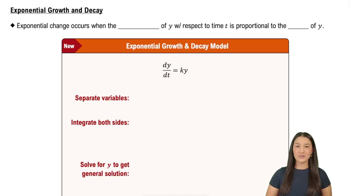
Exponential Growth & Decay
Pratica correlata
Domanda del libro di testo

Given the velocity function of an object moving along a line, explain how definite integrals can be used to find the displacement of the object.

23
views

Domanda del libro di testo

Let R be the region in the first quadrant bounded above by the curve y=2−x² and bounded below by the line y=x. Suppose the shell method is used to determine the volume of the solid generated by revolving R about the y-axis.

b. What is the height of a cylindrical shell at a point x in [0, 2]?

138
views
Domanda del libro di testo

21–30. {Use of Tech} Arc length by calculator


b. If necessary, use technology to evaluate or approximate the integral.

y = cos 2x, for 0 ≤ x ≤ π

49
views
Domanda del libro di testo

Emptying a water trough A water trough has a semicircular cross section with a radius of 0.25 m and a length of 3 m (see figure).

a. How much work is required to pump the water out of the trough (to the level of the top of the trough) when it is full?

65
views
Domanda del libro di testo

A vertical spring A 10-kg mass is attached to a spring that hangs vertically and is stretched 2 m from the equilibrium position of the spring. Assume a linear spring with F(x) = kx.

a. How much work is required to compress the spring and lift the mass 0.5 m?

62
views
Domanda del libro di testo

Oscillating growth rates Some species have growth rates that oscillate with an (approximately) constant period P. Consider the growth rate function N'(t) = r+A sin 2πt/P, where A and r are constants with units of individuals/yr, and t is measured in years. A species becomes extinct if its population ever reaches 0 after t=0.


b. Suppose P=10, A=20, and r=0. If the initial population is N(0)=100, does the population ever become extinct? Explain.

51
views