Ch. 6 - Applications of Integration
Briggs - Calculus: Early Transcendentals 3rd Edition
Briggs3rd EditionCalculus: Early TranscendentalsISBN: 9780136847243Non è quello che usi tu?Cambia libro di testo
Capitolo 6, Problema 6.7.42a

Emptying a water trough A water trough has a semicircular cross section with a radius of 0.25 m and a length of 3 m (see figure).
a. How much work is required to pump the water out of the trough (to the level of the top of the trough) when it is full?
<IMAGE>

Guida verificata passo dopo passo
1
Identify the shape and dimensions of the trough: it has a semicircular cross section with radius \(r = 0.25\) m and length \(L = 3\) m.
Set up a coordinate system for the vertical direction, letting \(y\) represent the depth of a thin horizontal slice of water measured from the bottom of the trough (where \(y=0\)) up to the top (where \(y=0.25\) m).
Express the width of the water slice at height \(y\). Since the cross section is semicircular, the width \(w(y)\) is twice the horizontal distance from the center to the edge, which can be found using the circle equation: \(w(y) = 2 \sqrt{r^2 - (r - y)^2}\).
Calculate the volume of a thin slice of water at height \(y\) with thickness \(dy\): \(dV = w(y) \times L \times dy\).
Determine the work to pump this slice to the top of the trough. The distance the water must be lifted is \((r - y)\), and the weight density of water is \(\rho g\) (where \(\rho\) is the density of water and \(g\) is acceleration due to gravity). The work for the slice is \(dW = \rho g \times dV \times (r - y)\). Integrate \(dW\) from \(y=0\) to \(y=r\) to find the total work.

Risposta video verificata per un problema simile:

Questa soluzione video è stata consigliata dai nostri tutor come utile per risolvere questo problema.
Durata del video:
4m

Concetti chiave

Ecco i concetti essenziali che devi comprendere per rispondere correttamente alla domanda.

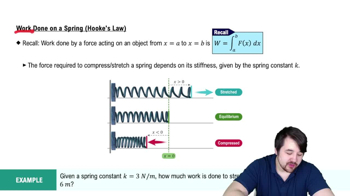
Work Done by a Variable Force

Work is the integral of force over distance. When pumping water, the force varies with the weight of each water slice and the distance it must be moved. Calculating work involves integrating the product of force and distance over the volume of water.
Video consigliato:
Percorso guidato
05:40
Work Done On A Spring (Hooke's Law)

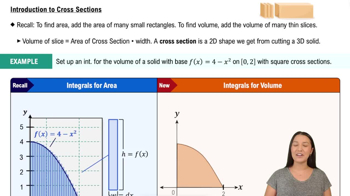
Volume and Cross-Sectional Area of a Semicircle

The trough has a semicircular cross section, so the area of a horizontal slice depends on the radius and the height of the water at that slice. Understanding how to express the area of a semicircle segment as a function of depth is essential for setting up the integral.
Video consigliato:
05:38
Introduction to Cross Sections

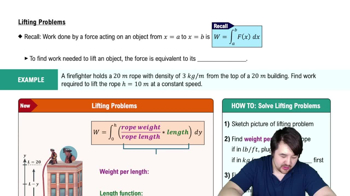
Density and Weight of Water

The force exerted by the water is its weight, which depends on the volume, density, and gravitational acceleration. Knowing the density of water allows conversion from volume to weight, which is necessary to calculate the force in the work integral.
Video consigliato:
Percorso guidato
09:32
Lifting Problems
Pratica correlata
Domanda del libro di testo

55–58. Marginal cost Consider the following marginal cost functions.


a. Find the additional cost incurred in dollars when production is increased from 100 units to 150 units.


C′(x) = 300+10x−0.01x²

89
views

Domanda del libro di testo

Given the velocity function of an object moving along a line, explain how definite integrals can be used to find the displacement of the object.

23
views
Domanda del libro di testo

6–8. Let R be the region bounded by the curves y = 2−√x,y=2, and x=4 in the first quadrant.


Suppose the shell method is used to determine the volume of the solid generated by revolving R about the line x=4.


a. What is the radius of a cylindrical shell at a point x in [0, 4]?

59
views
Domanda del libro di testo

{Use of Tech} Oscillating motion A mass hanging from a spring is set in motion, and its ensuing velocity is given by v(t) = 2π cos πt, for t≥0. Assume the positive direction is upward and s(0)=0. 


a. Determine the position function, for t≥0.

68
views
Domanda del libro di testo

13–16. Displacement from velocity Consider an object moving along a line with the given velocity v. Assume time t is measured in seconds and velocities have units of m/s.


b. Find the displacement over the given interval. 


v(t) = 50e^−2t on [0, 4]

30
views
Domanda del libro di testo

A vertical spring A 10-kg mass is attached to a spring that hangs vertically and is stretched 2 m from the equilibrium position of the spring. Assume a linear spring with F(x) = kx.

a. How much work is required to compress the spring and lift the mass 0.5 m?

62
views