Ch. 6 - Applications of Integration
Briggs - Calculus: Early Transcendentals 3rd Edition
Briggs3rd EditionCalculus: Early TranscendentalsISBN: 9780136847243Non è quello che usi tu?Cambia libro di testo
Capitolo 6, Problema 6.R.47

43–55. Volumes of solids Choose the general slicing method, the disk/washer method, or the shell method to answer the following questions.


The region bounded by the curve y = 1+√x, the curve y = 1−√x, and the line x=1 is revolved about the y-axis. Find the volume of the resulting solid by (a) integrating with respect to x and (b) integrating with respect to y. Be sure your answers agree.

Guida verificata passo dopo passo
1
First, understand the region bounded by the curves: \(y = 1 + \sqrt{x}\), \(y = 1 - \sqrt{x}\), and the vertical line \(x = 1\). Sketching the region helps visualize the area to be revolved around the y-axis.
For part (a), integrating with respect to \(x\): Since the solid is formed by revolving around the y-axis, use the shell method. The shell radius is the distance from the y-axis, which is \(x\), and the shell height is the difference between the upper and lower curves, \(\left( (1 + \sqrt{x}) - (1 - \sqrt{x}) \right) = 2\sqrt{x}\). The volume integral is then \(V = \int_0^1 2\pi \cdot (\text{radius}) \cdot (\text{height}) \, dx\).
Set up the integral for part (a): \(V = \int_0^1 2\pi x \cdot 2\sqrt{x} \, dx = \int_0^1 4\pi x \sqrt{x} \, dx\). Simplify the integrand before integrating.
For part (b), integrating with respect to \(y\): Express \(x\) in terms of \(y\) from the given curves. From \(y = 1 + \sqrt{x}\), solve for \(x\) to get \(x = (y - 1)^2\). Similarly, from \(y = 1 - \sqrt{x}\), \(x = (1 - y)^2\). The region in \(y\) goes from \(y = 0\) to \(y = 2\) (since at \(x=1\), \(y\) ranges between \(1 - 1 = 0\) and \(1 + 1 = 2\)).
Use the disk/washer method for part (b): The radius of the washers is the horizontal distance from the y-axis to the outer curve minus the inner curve, which is \(R(y) = 1\) (since \(x=1\) is the boundary) and \(r(y) = (1 - y)^2\) or \((y - 1)^2\) depending on the side. Set up the volume integral as \(V = \int_0^2 \pi \left( R(y)^2 - r(y)^2 \right) dy\). Evaluate this integral to find the volume.

Risposta video verificata per un problema simile:

Questa soluzione video è stata consigliata dai nostri tutor come utile per risolvere questo problema.
Durata del video:
5m

Concetti chiave

Ecco i concetti essenziali che devi comprendere per rispondere correttamente alla domanda.

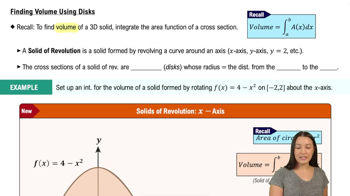
Volume of Solids of Revolution

This concept involves finding the volume of a 3D solid formed by rotating a 2D region around an axis. The volume can be computed using integral calculus by summing infinitesimal cross-sectional areas perpendicular to the axis of rotation.
Video consigliato:
04:48
Finding Volume Using Disks

Disk/Washer and Shell Methods

These are two common techniques for finding volumes of solids of revolution. The disk/washer method slices perpendicular to the axis, using circular cross-sections, while the shell method uses cylindrical shells by slicing parallel to the axis. Choosing the appropriate method simplifies integration.
Video consigliato:
06:30
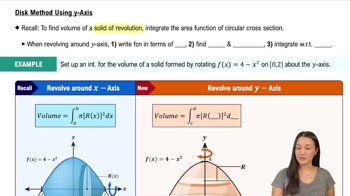
Disk Method Using y-Axis

Integration with Respect to Different Variables

Integrating with respect to x or y changes the approach to setting up the integral, affecting limits and expressions for radii or heights. Understanding how to express the region and boundaries in terms of each variable is essential to ensure consistent volume calculations.
Video consigliato:
04:27
Substitution With an Extra Variable
Pratica correlata
Domanda del libro di testo

14–25. {Use of Tech} Areas of regions Determine the area of the given region.


The region in the first quadrant bounded by y = x/6 and y = 1−|x/2−1|

38
views

Domanda del libro di testo

Two methods The region R in the first quadrant bounded by the parabola y = 4-x² and coordinate axes is revolved about the y-axis to produce a dome-shaped solid. Find the volume of the solid in the following ways:


a. Apply the disk method and integrate with respect to y.

97
views
Domanda del libro di testo

27–33. Multiple regions The regions R₁,R₂, and R₃ (see figure) are formed by the graphs of y = 2√x,y = 3−x,and x=3.


Use the shell method to find an integral, or sum of integrals, that equals the volume of the solid obtained by revolving region R₃ about the line x=3. Do not evaluate the integral.

48
views
Domanda del libro di testo

43–55. Volumes of solids Choose the general slicing method, the disk/washer method, or the shell method to answer the following questions.


The region bounded by the graphs of y = 2x,y = 6−x, and y = 0 is revolved about the line y = −2 and the line x = −2. Find the volumes of the resulting solids. Which one is greater?

79
views
Domanda del libro di testo

58–61. Arc length Find the length of the following curves.

y = x³/6 + 1/2x on [1,2]

77
views
Domanda del libro di testo

Lifting problem A 4-kg mass is attached to the bottom of a 5-m, 15-kg chain. If the chain hangs from a platform, how much work is required to pull the chain and the mass onto the platform?

68
views