Ch. 6 - Applications of Integration
Briggs - Calculus: Early Transcendentals 3rd Edition
Briggs3rd EditionCalculus: Early TranscendentalsISBN: 9780136847243Non è quello che usi tu?Cambia libro di testo
Capitolo 6, Problema 6.R.55a

43–55. Volumes of solids Choose the general slicing method, the disk/washer method, or the shell method to answer the following questions.


The region bounded by the graphs of y = 2x,y = 6−x, and y = 0 is revolved about the line y = −2 and the line x = −2. Find the volumes of the resulting solids. Which one is greater?

Guida verificata passo dopo passo
1
First, identify the region bounded by the curves: \(y = 2x\), \(y = 6 - x\), and \(y = 0\). Sketching or analyzing these will help visualize the area to be revolved.
Determine the points of intersection between \(y = 2x\) and \(y = 6 - x\) by setting \(2x = 6 - x\) and solving for \(x\). This gives the limits of integration for the region.
For the solid revolved about the line \(y = -2\), use the disk/washer method because the axis of rotation is horizontal and outside the region. Express the radius of each disk/washer as the distance from the curve to \(y = -2\).
Set up the volume integral for revolution about \(y = -2\) as \(V = \pi \int_{a}^{b} \left[ (R_{outer})^2 - (R_{inner})^2 \right] \, dx\), where \(R_{outer}\) and \(R_{inner}\) are the distances from the curves to the line \(y = -2\).
For the solid revolved about the line \(x = -2\), use the shell method because the axis of rotation is vertical and outside the region. Express the height of each shell as the difference between the two curves and the radius as the distance from \(x\) to \(-2\). Set up the volume integral as \(V = 2\pi \int_{a}^{b} (radius)(height) \, dx\).

Risposta video verificata per un problema simile:

Questa soluzione video è stata consigliata dai nostri tutor come utile per risolvere questo problema.
Durata del video:
7m

Concetti chiave

Ecco i concetti essenziali che devi comprendere per rispondere correttamente alla domanda.

Volume of Solids of Revolution

This concept involves finding the volume of a 3D solid formed by rotating a 2D region around a line (axis). The volume is calculated by integrating cross-sectional areas perpendicular to the axis of rotation, using methods like disks, washers, or shells.
Video consigliato:
04:48
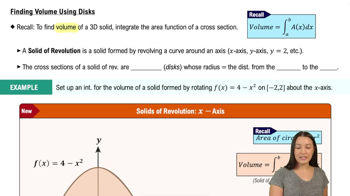
Finding Volume Using Disks

Disk/Washer and Shell Methods

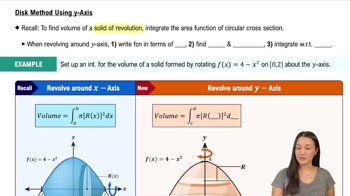
The disk/washer method uses circular cross-sections perpendicular to the axis of rotation, suitable when the axis is horizontal or vertical. The shell method integrates cylindrical shells parallel to the axis, often simplifying calculations when the axis is not a boundary of the region.
Video consigliato:
06:30
Disk Method Using y-Axis

Setting up the Integral with Correct Bounds and Axis

Accurately determining the limits of integration and the distance from the region to the axis of rotation is crucial. This includes rewriting functions if needed, adjusting for shifts in the axis (like y = -2 or x = -2), and choosing the variable of integration to simplify the integral.
Video consigliato:
Percorso guidato
11:11
Improper Integrals: Infinite Intervals