
Ch. 6 - Applications of Integration
Briggs - Calculus: Early Transcendentals 3rd Edition
Briggs3rd EditionCalculus: Early TranscendentalsISBN: 9780136847243Non è quello che usi tu?Cambia libro di testo
Capitolo 6, Problema 6.RE.9a

Fuel consumption A small plane in flight consumes fuel at a rate (in gal/min) given by
R'(t) ={ 4t^{1/3} if 0 ≤ t ≤ 8 (take-off)
2 if t> 0 (cruising)
a. Find a function R that gives the total fuel consumed, for 0≤t≤8.

Guida verificata passo dopo passo
1
Identify the given rate of fuel consumption function for the time interval 0 \(\leq\) t \(\leq\) 8, which is R'(t) = 4t^{1/3}. This represents the rate of fuel consumption in gallons per minute during take-off.
Recall that to find the total fuel consumed function R(t), you need to integrate the rate function R'(t) with respect to time t over the interval from 0 to t.
Set up the integral: R(t) = \(\int\) 4t^{1/3} \, dt. This integral will give the total fuel consumed from time 0 up to time t during take-off.
Perform the integration by applying the power rule for integrals: \(\int\) t^{n} \, dt = \(\frac{t^{n+1}\)}{n+1} + C. Here, n = \(\frac{1}{3}\), so integrate accordingly and include the constant of integration C.
Use the initial condition R(0) = 0 (since no fuel is consumed at time zero) to solve for the constant C, ensuring the total fuel consumed function R(t) correctly models the situation.

Risposta video verificata per un problema simile:

Questa soluzione video è stata consigliata dai nostri tutor come utile per risolvere questo problema.
Durata del video:
2m

Concetti chiave

Ecco i concetti essenziali che devi comprendere per rispondere correttamente alla domanda.

Rate of Change and Derivatives

The rate of change represents how a quantity changes over time, often expressed as a derivative. In this problem, R'(t) is the rate of fuel consumption, showing how many gallons are used per minute at time t. Understanding derivatives helps interpret and work with rates in real-world contexts.
Video consigliato:
Percorso guidato
04:16
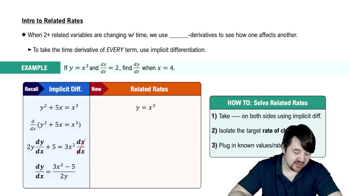
Intro To Related Rates

Integration to Find Accumulated Quantity

Integration is the reverse process of differentiation and is used to find the total accumulated amount from a rate function. Here, integrating R'(t) over time gives the total fuel consumed, R(t), between 0 and 8 minutes. This concept connects rates to total quantities.
Video consigliato:
Percorso guidato
09:15
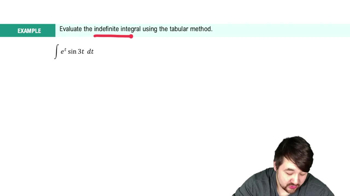
Tabular Integration by Parts Example 6

Piecewise Functions

Piecewise functions define different expressions over different intervals. The fuel consumption rate R'(t) changes form at t=8, requiring careful handling of each interval separately. Understanding piecewise functions ensures correct application of integration and interpretation of the problem.
Video consigliato:
Percorso guidato
05:36
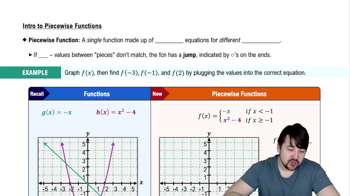
Piecewise Functions
Pratica correlata
Domanda del libro di testo

2–3. Displacement, distance, and position Consider an object moving along a line with the following velocities and initial positions. Assume time t is measured in seconds and velocities have units of m/s.


d. Determine the position function s(t) using the Fundamental Theorem of Calculus (Theorem 6.1). Check your answer by finding the position function using the antiderivative method.


v(t) = 12t²-30t+12, for 0 ≤ t ≤ 3; s(0)=1

47
views
Domanda del libro di testo

Area and volume The region R is bounded by the curves x = y²+2,y=x−4, and y=0 (see figure).

b. Write a single integral that gives the volume of the solid generated when R is revolved about the x-axis.

94
views
Domanda del libro di testo

43–55. Volumes of solids Choose the general slicing method, the disk/washer method, or the shell method to answer the following questions.


The region bounded by the graphs of y = 2x,y = 6−x, and y = 0 is revolved about the line y = −2 and the line x = −2. Find the volumes of the resulting solids. Which one is greater?

71
views
Domanda del libro di testo

Variable gravity At Earth’s surface, the acceleration due to gravity is approximately g=9.8 m/s² (with local variations). However, the acceleration decreases with distance from the surface according to Newton’s law of gravitation. At a distance of y meters from Earth’s surface, the acceleration is given by a(y) = - g / (1+y/R)², where R=6.4×10⁶ m is the radius of Earth.


f. Graph ymax as a function of v0. What is the maximum height when v0=500 m/s,1500 m/s, and 5 km/s?

88
views
Domanda del libro di testo

Explain why or why not Determine whether the following statements are true and give an explanation or counterexample.

b. Given only the velocity of an object moving on a line, it is possible to find its displacement, but not its position.

47
views
Domanda del libro di testo

70–72. Variable density in one dimension Find the mass of the following thin bars.


A bar on the interval 0≤x≤6 with a density ρ(x) = {1 if 0 ≤ x < 2

2 if 2 ≤ x < 4

4 if 4 ≤ x ≤ 6

48
views