Ch. 6 - Applications of Integration
Briggs - Calculus: Early Transcendentals 3rd Edition
Briggs3rd EditionCalculus: Early TranscendentalsISBN: 9780136847243Non è quello che usi tu?Cambia libro di testo
Capitolo 6, Problema 6.4.28

9-34. Shell method Let R be the region bounded by the following curves. Use the shell method to find the volume of the solid generated when R is revolved about indicated axis. 


{Use of Tech} y = √sin^−1x,y = √π/2, and x=0; about the x-axis

Guida verificata passo dopo passo
1
First, identify the region R bounded by the curves: \( y = \sqrt{\sin^{-1} x} \), \( y = \sqrt{\frac{\pi}{2}} \), and \( x = 0 \). Understand that \( \sin^{-1} x \) is the inverse sine function, also called arcsin, which outputs values in radians.
Since the solid is generated by revolving the region about the x-axis, and the shell method involves cylindrical shells formed by revolving vertical slices, consider using horizontal slices instead. However, the shell method is typically easier when revolving around the x-axis if we integrate with respect to \( y \).
Express \( x \) in terms of \( y \) from the equation \( y = \sqrt{\sin^{-1} x} \). Square both sides to get \( y^2 = \sin^{-1} x \), then solve for \( x \) as \( x = \sin(y^2) \). This will be the radius function for the shells.
Set up the volume integral using the shell method formula for revolution about the x-axis: \(\n\[\n\)\[ V = 2\pi \int_{a}^{b} (\text{radius}) \times (\text{height}) \, dy \]\(\n\]\nHere\), the radius is the distance from the x-axis to the shell, which is \( y \), and the height is the horizontal length of the shell, which is \( x = \sin(y^2) - 0 = \sin(y^2) \). The limits of integration \( a \) and \( b \) correspond to the y-values bounding the region, from \( y = 0 \) to \( y = \sqrt{\frac{\pi}{2}} \).
Write the integral explicitly: \(\n\[\n\)\[ V = 2\pi \int_{0}^{\sqrt{\frac{\pi}{2}}} y \cdot \sin(y^2) \, dy \]\(\n\]\nThis\) integral represents the volume of the solid generated by revolving the region about the x-axis using the shell method. The next step would be to evaluate this integral, possibly using substitution, but as per instructions, we stop here.

Risposta video verificata per un problema simile:

Questa soluzione video è stata consigliata dai nostri tutor come utile per risolvere questo problema.
Durata del video:
7m

Concetti chiave

Ecco i concetti essenziali che devi comprendere per rispondere correttamente alla domanda.

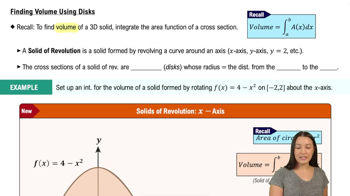
Shell Method for Volume

The shell method calculates the volume of a solid of revolution by integrating cylindrical shells. Each shell's volume is approximated by its circumference times height times thickness. This method is especially useful when the axis of rotation is parallel to the axis of the variable of integration.
Video consigliato:
04:48
Finding Volume Using Disks

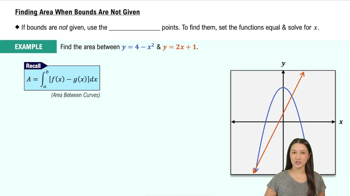
Region Bounded by Curves

Understanding the region bounded by the given curves is essential to set correct integration limits. Here, the region is bounded by y = √(sin⁻¹x), y = √(π/2), and x = 0, which defines the shape and size of the area to be revolved around the x-axis.
Video consigliato:
05:06
Finding Area When Bounds Are Not Given

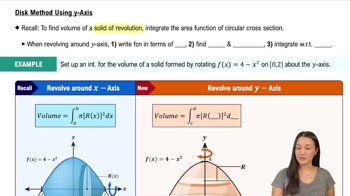
Revolution About the x-axis

Revolving a region about the x-axis means rotating it horizontally, which affects how the shells are formed. For the shell method, the radius of each shell is the distance from the shell to the axis of rotation, and the height corresponds to the function values along the axis perpendicular to the x-axis.
Video consigliato:
06:30
Disk Method Using y-Axis
Pratica correlata
Domanda del libro di testo

Let R be the region bounded by the following curves. Find the volume of the solid generated when R is revolved about the given axis.


y=√sin x,y=1, and x=0; about the x-axis 

67
views

Domanda del libro di testo

9-34. Shell method Let R be the region bounded by the following curves. Use the shell method to find the volume of the solid generated when R is revolved about indicated axis. 


{Use of Tech} y² = ln x,y² = ln x³, and y=2; about the x-axis

58
views
Domanda del libro di testo

60–63. Equivalent constant velocity Consider the following velocity functions. In each case, complete the sentence: The same distance could have been traveled over the given time period at a constant velocity of ________.


v(t) = t(25−t²)^1/2, for 0≤t≤5

31
views
Domanda del libro di testo

9–20. Arc length calculations Find the arc length of the following curves on the given interval.

y = −8x−3 on [−2, 6] (Use calculus.)

38
views
Domanda del libro di testo

9–12. Consider the cylindrical tank in Example 4 that has a height of 10 m and a radius of 5 m. Recall that if the tank is full of water, then ∫₀¹⁰ 25 π ρg(15−y) dy equals the work required to pump all the water out of the tank, through an outflow pipe that is 15 m above the bottom of the tank. Revise this work integral for the following scenarios. (Do not evaluate the integrals.)


The work required to empty the top half of the tank

91
views
Domanda del libro di testo

Find the area of the region described in the following exercises.


The region bounded by x=y(y−1) and y=x/3

64
views