
Ch. 6 - Applications of Integration
Briggs - Calculus: Early Transcendentals 3rd Edition
Briggs3rd EditionCalculus: Early TranscendentalsISBN: 9780136847243Non è quello che usi tu?Cambia libro di testo
Capitolo 6, Problema 6.1.37d

Acceleration A drag racer accelerates at a(t)=88 ft/s². Assume v(0)=0, s(0)=0, and t is measured in seconds.


d. How long does it take the racer to travel 300 ft?

Guida verificata passo dopo passo
1
Identify the given acceleration function: \(a(t) = 88\) ft/s², which is constant.
Since acceleration is the derivative of velocity, integrate \(a(t)\) with respect to \(t\) to find the velocity function: \(v(t) = \int a(t) \, dt = \int 88 \, dt\).
Use the initial condition \(v(0) = 0\) to solve for the constant of integration in the velocity function.
Next, integrate the velocity function \(v(t)\) with respect to \(t\) to find the position function \(s(t)\): \(s(t) = \int v(t) \, dt\).
Use the initial condition \(s(0) = 0\) to solve for the constant of integration in the position function, then set \(s(t) = 300\) ft and solve for \(t\) to find the time it takes to travel 300 ft.

Risposta video verificata per un problema simile:

Questa soluzione video è stata consigliata dai nostri tutor come utile per risolvere questo problema.
Durata del video:
3m

Concetti chiave

Ecco i concetti essenziali che devi comprendere per rispondere correttamente alla domanda.

Acceleration and Its Relationship to Velocity and Position

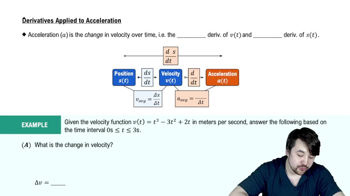
Acceleration is the rate of change of velocity with respect to time. Given acceleration a(t), velocity v(t) can be found by integrating a(t). Similarly, position s(t) is found by integrating velocity. Understanding these relationships allows us to move from acceleration to position over time.
Video consigliato:
Percorso guidato
06:15
Derivatives Applied To Acceleration

Initial Conditions in Integration

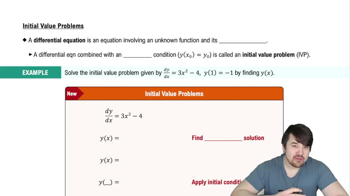
Initial conditions such as v(0) = 0 and s(0) = 0 provide specific values needed to solve the constants of integration when finding velocity and position functions. These conditions ensure the solution matches the physical scenario described.
Video consigliato:
Percorso guidato
05:03
Initial Value Problems

Solving for Time from Position Function

Once the position function s(t) is determined, solving for the time t when s(t) equals a given distance (300 ft) involves algebraic manipulation. This step finds the exact time required for the racer to travel the specified distance.
Video consigliato:
Percorso guidato
4:46
Adding & Subtracting Functions Example 1
Pratica correlata
Domanda del libro di testo

Use the region R that is bounded by the graphs of y=1+√x,x=4, and y=1 complete the exercises.


Region R is revolved about the y-axis to form a solid of revolution whose cross sections are washers.


d. Write an integral for the volume of the solid.

54
views
Domanda del libro di testo

9–10. Velocity graphs The figures show velocity functions for motion along a line. Assume the motion begins with an initial position of s(0)=0. Determine the following.

d. A piecewise function for s(t)

89
views
Domanda del libro di testo

Use the region R that is bounded by the graphs of y=1+√x,x=4, and y=1 complete the exercises.


Region R is revolved about the x-axis to form a solid of revolution whose cross sections are washers.


d. Write an integral for the volume of the solid.

126
views
Domanda del libro di testo

Displacement and distance from velocity Consider the velocity function shown below of an object moving along a line. Assume time is measured in seconds and distance is measured in meters. The areas of four regions bounded by the velocity curve and the t-axis are also given.

d. What is the displacement of the object over the interval [0, 8]? 

75
views
Domanda del libro di testo

9–10. Velocity graphs The figures show velocity functions for motion along a line. Assume the motion begins with an initial position of s(0)=0. Determine the following.

d. A piecewise function for s(t)

54
views
Domanda del libro di testo

Determine whether the following statements are true and give an explanation or counterexample. 


d. Let f(x)=12x^2.. The area of the surface generated when the graph of f on [−4, 4] is revolved about the y-axis is twice the area of the surface generated when the graph of f on [0, 4] is revolved about the y-axis.

56
views