

Ch. 6 - Applications of Integration
Briggs - Calculus: Early Transcendentals 3rd Edition
Briggs3rd EditionCalculus: Early TranscendentalsISBN: 9780136847243Non è quello che usi tu?Cambia libro di testo
Capitolo 6, Problema 6.1.50b

Blood flow A typical human heart pumps 70 mL of blood (the stroke volume) with each beat. Assuming a heart rate of 60 beats/min (1 beat/s), a reasonable model for the outflow rate of the heart is V′(t)=70(1+sin 2πt), where V(t) is the amount of blood (in milliliters) pumped over the interval [0,t],V(0)=0 and t is measured in seconds.


b. Find the function that gives the total blood pumped between t=0 and a future time t>0.

Guida verificata passo dopo passo
1
Identify the given rate of blood flow as the derivative of the volume function: \(V'(t) = 70(1 + \sin(2\pi t))\) milliliters per second.
Recall that to find the total volume pumped over time, you need to find the original function \(V(t)\) by integrating the rate function \(V'(t)\) with respect to \(t\).
Set up the integral: \(V(t) = \int 70(1 + \sin(2\pi t)) \, dt\).
Split the integral into two parts for easier integration: \(V(t) = 70 \int 1 \, dt + 70 \int \sin(2\pi t) \, dt\).
Integrate each part separately, remembering to include the constant of integration \(C\), and then use the initial condition \(V(0) = 0\) to solve for \(C\).

Risposta video verificata per un problema simile:

Questa soluzione video è stata consigliata dai nostri tutor come utile per risolvere questo problema.
Durata del video:
4m

Concetti chiave

Ecco i concetti essenziali che devi comprendere per rispondere correttamente alla domanda.

Understanding the Derivative as a Rate of Change

The derivative V′(t) represents the instantaneous rate at which blood is pumped by the heart at time t. Recognizing that V′(t) is the rate of change of the total volume V(t) is essential to relate the given function to the total blood pumped over time.
Video consigliato:
Percorso guidato
04:16
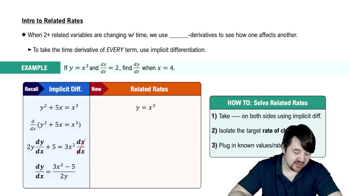
Intro To Related Rates

Definite Integration to Find Accumulated Quantity

To find the total blood pumped from time 0 to t, we integrate the rate function V′(t) over [0, t]. Integration accumulates the instantaneous rates over time, yielding the total volume V(t). This process reverses differentiation and uses the initial condition to find the constant of integration.
Video consigliato:
Percorso guidato
05:43
Definition of the Definite Integral

Applying Initial Conditions to Determine the Integration Constant

Since V(0) = 0, the initial amount of blood pumped is zero. After integrating V′(t), we use this initial condition to solve for the constant of integration, ensuring the function V(t) accurately models the total blood volume pumped starting from zero.
Video consigliato:
Percorso guidato
06:46
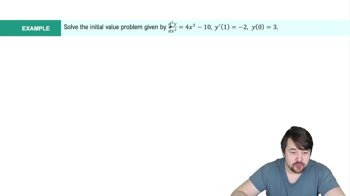
Initial Value Problems Example 1
Pratica correlata
Domanda del libro di testo

6–8. Let R be the region bounded by the curves y = 2−√x,y=2, and x=4 in the first quadrant.

Suppose the shell method is used to determine the volume of the solid generated by revolving R about the line x=4.


b. What is the height of a cylindrical shell at a point x in [0, 4]?

88
views
Domanda del libro di testo

Displacement and distance from velocity Consider the velocity function shown below of an object moving along a line. Assume time is measured in seconds and distance is measured in meters. The areas of four regions bounded by the velocity curve and the t-axis are also given.

b. What is the displacement of the object over the interval [2, 6]? 

60
views
Domanda del libro di testo

55–58. Marginal cost Consider the following marginal cost functions.


b. Find the additional cost incurred in dollars when production is increased from 500 units to 550 units.


C′(x)=200−0.05x

58
views
Domanda del libro di testo

Distance traveled and displacement Suppose an object moves along a line with velocity (in ft/s) v(t)=6−2t, for 0≤t≤6, where t is measured in seconds.


b. Find the displacement of the object on the interval 0≤t≤6.

32
views
Domanda del libro di testo

Work done by a spring A spring on a horizontal surface can be stretched and held 0.5 m from its equilibrium position with a force of 50 N.

b. How much work is done in compressing the spring 0.5 m from its equilibrium position?

89
views
Domanda del libro di testo

55–58. Marginal cost Consider the following marginal cost functions.


b. Find the additional cost incurred in dollars when production is increased from 500 units to 550 units.


C′(x) = 300+10x−0.01x²

50
views