
Ch. 6 - Applications of Integration
Briggs - Calculus: Early Transcendentals 3rd Edition
Briggs3rd EditionCalculus: Early TranscendentalsISBN: 9780136847243Non è quello che usi tu?Cambia libro di testo
Capitolo 6, Problema 6.7.25b

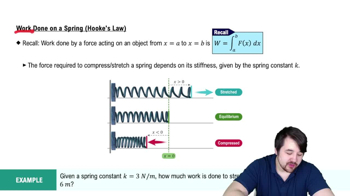
Work done by a spring A spring on a horizontal surface can be stretched and held 0.5 m from its equilibrium position with a force of 50 N.
b. How much work is done in compressing the spring 0.5 m from its equilibrium position?

Guida verificata passo dopo passo
1
Identify the spring constant \( k \) using Hooke's Law, which states that the force \( F \) required to stretch or compress a spring is proportional to the displacement \( x \): \[ F = k \times x \] Given \( F = 50 \) N and \( x = 0.5 \) m, solve for \( k \).
Recall that the work done \( W \) in stretching or compressing a spring from its equilibrium position to a displacement \( x \) is given by the formula for elastic potential energy: \[ W = \frac{1}{2} k x^2 \]
Substitute the value of \( k \) found in step 1 and the displacement \( x = 0.5 \) m into the work formula.
Calculate the expression to find the amount of work done in compressing the spring 0.5 m from its equilibrium position.
Interpret the result as the energy stored in the spring due to compression.

Risposta video verificata per un problema simile:

Questa soluzione video è stata consigliata dai nostri tutor come utile per risolvere questo problema.
Durata del video:
2m

Concetti chiave

Ecco i concetti essenziali che devi comprendere per rispondere correttamente alla domanda.

Hooke's Law

Hooke's Law states that the force exerted by a spring is proportional to its displacement from the equilibrium position, expressed as F = kx, where k is the spring constant and x is the displacement. This law helps determine the spring constant from the given force and displacement.
Video consigliato:
Percorso guidato
05:40
Work Done On A Spring (Hooke's Law)

Spring Constant

The spring constant (k) measures the stiffness of a spring and is calculated by dividing the force applied by the displacement (k = F/x). Knowing k allows us to quantify how much force is needed to stretch or compress the spring by a certain amount.
Video consigliato:
Percorso guidato
05:40
Work Done On A Spring (Hooke's Law)

Work Done by a Spring

The work done in stretching or compressing a spring is the energy stored in it, calculated by W = (1/2)kx². This formula integrates the variable force over the displacement, reflecting that more work is needed as the spring stretches further.
Video consigliato:
Percorso guidato
05:40
Work Done On A Spring (Hooke's Law)
Pratica correlata
Domanda del libro di testo

Displacement and distance from velocity Consider the velocity function shown below of an object moving along a line. Assume time is measured in seconds and distance is measured in meters. The areas of four regions bounded by the velocity curve and the t-axis are also given.

b. What is the displacement of the object over the interval [2, 6]? 

60
views
Domanda del libro di testo

Winding a chain A 30-m-long chain hangs vertically from a cylinder attached to a winch. Assume there is no friction in the system and the chain has a density of 5kg/m.

b. How much work is required to wind the chain onto the cylinder if a 50-kg block is attached to the end of the chain?

39
views
Domanda del libro di testo

Consider the following curves on the given intervals.  


b. Use a calculator or software to approximate the surface area.


y=cos x, for 0≤x≤π/2; about the x-axis

62
views
Domanda del libro di testo

"Determine whether the following statements are true and give an explanation or counterexample.


b. The volume of a hemisphere can be computed using the disk method. "

68
views
Domanda del libro di testo

Blood flow A typical human heart pumps 70 mL of blood (the stroke volume) with each beat. Assuming a heart rate of 60 beats/min (1 beat/s), a reasonable model for the outflow rate of the heart is V′(t)=70(1+sin 2πt), where V(t) is the amount of blood (in milliliters) pumped over the interval [0,t],V(0)=0 and t is measured in seconds.


b. Find the function that gives the total blood pumped between t=0 and a future time t>0.

30
views
Domanda del libro di testo

55–58. Marginal cost Consider the following marginal cost functions.


b. Find the additional cost incurred in dollars when production is increased from 500 units to 550 units.


C′(x) = 300+10x−0.01x²

50
views