
Ch. 6 - Applications of Integration
Briggs - Calculus: Early Transcendentals 3rd Edition
Briggs3rd EditionCalculus: Early TranscendentalsISBN: 9780136847243Non è quello che usi tu?Cambia libro di testo
Capitolo 6, Problema 6.RE.1c

Explain why or why not Determine whether the following statements are true and give an explanation or counterexample.
c. If water flows into a tank at a constant rate (for example, 6 gal/min), the volume of water in the tank increases according to a linear function of time.

Guida verificata passo dopo passo
1
Identify the given situation: water flows into a tank at a constant rate, for example, 6 gallons per minute.
Recall the definition of a linear function: a function of the form $f(t) = mt + b$, where \(m\) and \(b\) are constants, and \(t\) represents time.
Since the rate of flow is constant, the volume of water added per unit time does not change, meaning the rate of change of volume with respect to time is constant.
Express the volume \(V(t)\) as a function of time \(t\): since the flow rate is 6 gal/min, the volume increases by 6 gallons every minute, so \(V(t) = 6t + V_0\), where \(V_0\) is the initial volume of water in the tank.
Conclude that because \(V(t)\) is of the form $mt + b$ with constant \(m=6\), the volume of water in the tank increases according to a linear function of time.

Risposta video verificata per un problema simile:

Questa soluzione video è stata consigliata dai nostri tutor come utile per risolvere questo problema.
Durata del video:
2m

Concetti chiave

Ecco i concetti essenziali che devi comprendere per rispondere correttamente alla domanda.

Linear Functions

A linear function describes a relationship where the output changes at a constant rate with respect to the input. Graphically, it forms a straight line, and algebraically, it can be expressed as f(t) = mt + b, where m is the constant rate of change.
Video consigliato:

Rate of Change and Accumulation

The rate of change represents how quickly a quantity changes over time. When a quantity accumulates at a constant rate, its total amount increases linearly, meaning the accumulated value is the integral of the constant rate over time.
Video consigliato:
Percorso guidato
04:16
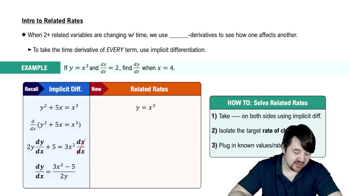
Intro To Related Rates

Relationship Between Derivatives and Functions

The derivative of a function gives the instantaneous rate of change. If the derivative is constant, the original function must be linear. In this context, a constant inflow rate (derivative) implies the volume function is linear in time.
Video consigliato:
06:30
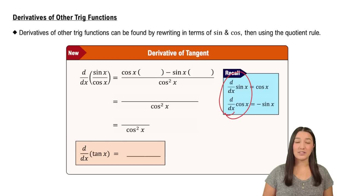
Derivatives of Other Trig Functions
Pratica correlata
Domanda del libro di testo

2–3. Displacement, distance, and position Consider an object moving along a line with the following velocities and initial positions. Assume time t is measured in seconds and velocities have units of m/s.


d. Determine the position function s(t) using the Fundamental Theorem of Calculus (Theorem 6.1). Check your answer by finding the position function using the antiderivative method.


v(t) = 12t²-30t+12, for 0 ≤ t ≤ 3; s(0)=1

47
views
Domanda del libro di testo

Filling a tank A 2000-liter cistern is empty when water begins flowing into it (at t=0 at a rate (in L/min) given by Q′(t) = 3√t, where t is measured in minutes.


a. How much water flows into the cistern in 1 hour?

68
views
Domanda del libro di testo

Work in a gravitational field For large distances from the surface of Earth, the gravitational force is given by F(x) = GMm / (x+R)², where G = 6.7×10^−11 N m²/kg² is the gravitational constant, M = 6×10^24 kg is the mass of Earth, m is the mass of the object in the gravitational field, R = 6.378×10⁶ m is the radius of Earth, and x≥0 is the distance above the surface of Earth (in meters).


a. How much work is required to launch a rocket with a mass of 500 kg in a vertical flight path to a height of 2500 km (from Earth’s surface)?

73
views
Domanda del libro di testo

Explain why or why not Determine whether the following statements are true and give an explanation or counterexample.

b. Given only the velocity of an object moving on a line, it is possible to find its displacement, but not its position.

47
views
Domanda del libro di testo

70–72. Variable density in one dimension Find the mass of the following thin bars.


A bar on the interval 0≤x≤6 with a density ρ(x) = {1 if 0 ≤ x < 2

2 if 2 ≤ x < 4

4 if 4 ≤ x ≤ 6

48
views
Domanda del libro di testo

A surface is generated by revolving the line f(x)=2−x, for 0≤x≤2, about the x-axis. Find the area of the resulting surface in the following ways.


a. Using calculus

67
views