

Ch. 6 - Applications of Integration
Briggs - Calculus: Early Transcendentals 3rd Edition
Briggs3rd EditionCalculus: Early TranscendentalsISBN: 9780136847243Non è quello che usi tu?Cambia libro di testo
Capitolo 6, Problema 6.RE.1b

Explain why or why not Determine whether the following statements are true and give an explanation or counterexample.
b. Given only the velocity of an object moving on a line, it is possible to find its displacement, but not its position.

Guida verificata passo dopo passo
1
Recall the definitions: velocity is the rate of change of position with respect to time, and displacement is the change in position over a time interval.
Understand that displacement over a time interval \([a, b]\) can be found by integrating the velocity function \(v(t)\) over that interval: \(\text{displacement} = \int_a^b v(t) \, dt\).
Note that position at a specific time requires an initial position value \(s(a)\), because position is given by \(s(t) = s(a) + \int_a^t v(\tau) \, d\tau\).
Since velocity alone does not provide the initial position \(s(a)\), you cannot determine the exact position function \(s(t)\), only the displacement over intervals.
Therefore, the statement is true: given only velocity, you can find displacement by integration, but you cannot find the exact position without additional information.

Risposta video verificata per un problema simile:

Questa soluzione video è stata consigliata dai nostri tutor come utile per risolvere questo problema.
Durata del video:
2m

Concetti chiave

Ecco i concetti essenziali che devi comprendere per rispondere correttamente alla domanda.

Velocity and Displacement Relationship

Velocity is the rate of change of position with respect to time, and displacement is the net change in position over a time interval. By integrating velocity over time, one can find the displacement, which measures how far and in what direction the object has moved from its initial position.
Video consigliato:
Percorso guidato
06:29
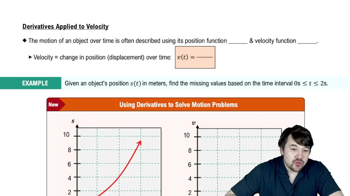
Derivatives Applied To Velocity

Position as an Initial Value Problem

To determine the exact position of an object from its velocity, an initial position value is required. Without knowing where the object started, velocity alone only provides information about changes in position, not the absolute position at any given time.
Video consigliato:
Percorso guidato
05:03
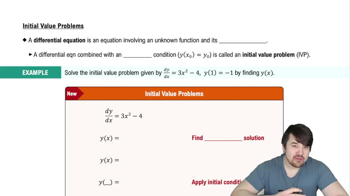
Initial Value Problems

Definite vs. Indefinite Integration in Kinematics

Integrating velocity to find displacement involves definite integration over a time interval, yielding a specific change in position. Finding position from velocity requires indefinite integration plus an initial condition, highlighting why velocity alone is insufficient to determine position uniquely.
Video consigliato:
Percorso guidato
05:43
Definition of the Definite Integral
Pratica correlata
Domanda del libro di testo

2–3. Displacement, distance, and position Consider an object moving along a line with the following velocities and initial positions. Assume time t is measured in seconds and velocities have units of m/s.


d. Determine the position function s(t) using the Fundamental Theorem of Calculus (Theorem 6.1). Check your answer by finding the position function using the antiderivative method.


v(t) = 12t²-30t+12, for 0 ≤ t ≤ 3; s(0)=1

47
views
Domanda del libro di testo

Explain why or why not Determine whether the following statements are true and give an explanation or counterexample.

c. If water flows into a tank at a constant rate (for example, 6 gal/min), the volume of water in the tank increases according to a linear function of time.

33
views
Domanda del libro di testo

Area and volume The region R is bounded by the curves x = y²+2,y=x−4, and y=0 (see figure).

b. Write a single integral that gives the volume of the solid generated when R is revolved about the x-axis.

94
views
Domanda del libro di testo

Variable gravity At Earth’s surface, the acceleration due to gravity is approximately g=9.8 m/s² (with local variations). However, the acceleration decreases with distance from the surface according to Newton’s law of gravitation. At a distance of y meters from Earth’s surface, the acceleration is given by a(y) = - g / (1+y/R)², where R=6.4×10⁶ m is the radius of Earth.


f. Graph ymax as a function of v0. What is the maximum height when v0=500 m/s,1500 m/s, and 5 km/s?

88
views
Domanda del libro di testo

70–72. Variable density in one dimension Find the mass of the following thin bars.


A bar on the interval 0≤x≤6 with a density ρ(x) = {1 if 0 ≤ x < 2

2 if 2 ≤ x < 4

4 if 4 ≤ x ≤ 6

48
views
Domanda del libro di testo

Fuel consumption A small plane in flight consumes fuel at a rate (in gal/min) given by

R'(t) ={ 4t^{1/3} if 0 ≤ t ≤ 8 (take-off)

2 if t> 0 (cruising)

a. Find a function R that gives the total fuel consumed, for 0≤t≤8.

64
views