
Ch. 6 - Applications of Integration
Briggs - Calculus: Early Transcendentals 3rd Edition
Briggs3rd EditionCalculus: Early TranscendentalsISBN: 9780136847243Non è quello che usi tu?Cambia libro di testo
Capitolo 6, Problema 6.2.7

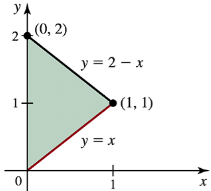
Express the area of the shaded region in Exercise 5 as the sum of two integrals with respect to y. Do not evaluate the integrals.
Shaded triangular region defined by lines y=2-x and y=x, with vertices at (0,2), (1,1), and (1,0).

Guida verificata passo dopo passo
1
Identify the region bounded by the lines \(y = 2 - x\) and \(y = x\), and the vertical line \(x = 1\). The vertices of the shaded triangular region are at points \((0, 2)\), \((1, 1)\), and \((1, 0)\).
Since the problem asks for the area expressed as the sum of two integrals with respect to \(y\), we need to rewrite the boundary curves in terms of \(x\) as functions of \(y\). From \(y = 2 - x\), solve for \(x\): \(x = 2 - y\). From \(y = x\), solve for \(x\): \(x = y\).
Determine the range of \(y\) values for the two parts of the region. The lower part of the region extends from \(y = 0\) to \(y = 1\), and the upper part extends from \(y = 1\) to \(y = 2\).
For \(0 \leq y \leq 1\), the left boundary is \(x = y\) and the right boundary is \(x = 1\). So, the area contribution here is the integral \(\int_0^1 (1 - y) \, dy\).
For \(1 \leq y \leq 2\), the left boundary is \(x = 0\) and the right boundary is \(x = 2 - y\). So, the area contribution here is the integral \(\int_1^2 (2 - y) \, dy\). The total area is the sum of these two integrals.

Risposta video verificata per un problema simile:

Questa soluzione video è stata consigliata dai nostri tutor come utile per risolvere questo problema.
Durata del video:
2m

Concetti chiave

Ecco i concetti essenziali che devi comprendere per rispondere correttamente alla domanda.

Setting up integrals with respect to y

When expressing area as integrals with respect to y, the region is sliced horizontally. This requires rewriting the boundary curves as functions of y (i.e., x in terms of y) and integrating over the y-intervals that cover the region. This approach is useful when the region is bounded more naturally by horizontal slices.
Video consigliato:
Percorso guidato
07:06
Integration by Parts for Definite Integrals Example 8

Finding inverse functions of boundary curves

To integrate with respect to y, the given functions y = 2 - x and y = x must be inverted to express x as functions of y. For example, from y = 2 - x, we get x = 2 - y, and from y = x, we get x = y. These inverse functions define the horizontal boundaries of the region for integration.
Video consigliato:
06:35
Derivatives of Other Inverse Trigonometric Functions

Partitioning the region for multiple integrals

The shaded region is divided into two parts along y = 1 because the left and right boundaries change at this point. Each part corresponds to a different pair of boundary functions in terms of y, so the total area is expressed as the sum of two integrals over different y-intervals.
Video consigliato:
Percorso guidato
07:45
Area of Polar Regions
Pratica correlata
Domanda del libro di testo

9-34. Shell method Let R be the region bounded by the following curves. Use the shell method to find the volume of the solid generated when R is revolved about indicated axis. 


x = x³ ,y = 1, and x = 0; about the x-axis

47
views
Domanda del libro di testo

29–36. Position and velocity from acceleration Find the position and velocity of an object moving along a straight line with the given acceleration, initial velocity, and initial position. Use the Fundamental Theorem of Calculus (Theorems 6.1 and 6.2).


a(t) = −32; v(0)=50; s(0)=0

69
views
Domanda del libro di testo

Look again at the region R in Figure 6.38 (p. 439). Explain why it would be difficult to use the washer method to find the volume of the solid of revolution that results when R is revolved about the y-axis.

53
views
Domanda del libro di testo

Suppose the region bounded by the curve y=f(x) from x=0 to x=4 (see figure) is revolved about the x-axis to form a solid of revolution. Use left, right, and midpoint Riemann sums, with n=4 subintervals of equal length, to estimate the volume of the solid of revolution.

35
views
Domanda del libro di testo

Use the general slicing method to find the volume of the following solids.

The solid whose base is the region bounded by the curves y=x^2 and y=2−x^2, and whose cross sections through the solid perpendicular to the x-axis are squares

91
views
Domanda del libro di testo

35–38. Shell and washer methods Let R be the region bounded by the following curves. Use both the shell method and the washer method to find the volume of the solid generated when R is revolved about the indicated axis.


y = 8,y = 2x+2,x = 0, and x=2; about the y-axis

53
views