Ch. 6 - Applications of Integration
Briggs - Calculus: Early Transcendentals 3rd Edition
Briggs3rd EditionCalculus: Early TranscendentalsISBN: 9780136847243Non è quello che usi tu?Cambia libro di testo
Capitolo 6, Problema 6.3.67

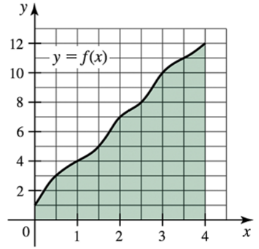
Suppose the region bounded by the curve y=f(x) from x=0 to x=4 (see figure) is revolved about the x-axis to form a solid of revolution. Use left, right, and midpoint Riemann sums, with n=4 subintervals of equal length, to estimate the volume of the solid of revolution.
fig

Guida verificata passo dopo passo
1
First, identify the interval over which the solid is formed, which is from \(x=0\) to \(x=4\). Since \(n=4\), divide this interval into 4 equal subintervals. The length of each subinterval is \(\Delta x = \frac{4-0}{4} = 1\).
Next, determine the sample points for the left Riemann sum, right Riemann sum, and midpoint Riemann sum. For the left sum, use the left endpoints of each subinterval: \(x=0, 1, 2, 3\). For the right sum, use the right endpoints: \(x=1, 2, 3, 4\). For the midpoint sum, use the midpoints of each subinterval: \(x=0.5, 1.5, 2.5, 3.5\).
From the graph, estimate the values of \(f(x)\) at each of these sample points. These values represent the radius of the solid at each point since the solid is revolved about the x-axis.
Use the formula for the volume of a solid of revolution using the disk method: \(V \approx \pi \sum_{i=1}^n [f(x_i)]^2 \Delta x\), where \(x_i\) are the sample points chosen (left, right, or midpoint). Calculate the sum of the squares of the function values at the sample points, multiply by \(\pi\) and \(\Delta x\).
Compute the three sums separately using the left endpoints, right endpoints, and midpoints to get three different estimates for the volume. This will give you the left Riemann sum estimate, right Riemann sum estimate, and midpoint Riemann sum estimate for the volume of the solid.

Risposta video verificata per un problema simile:

Questa soluzione video è stata consigliata dai nostri tutor come utile per risolvere questo problema.
Durata del video:
4m

Concetti chiave

Ecco i concetti essenziali che devi comprendere per rispondere correttamente alla domanda.

Solid of Revolution

A solid of revolution is formed when a region in the plane is revolved around an axis, creating a three-dimensional object. In this problem, revolving the area under y = f(x) from x = 0 to x = 4 about the x-axis generates a solid whose volume can be found by integrating the cross-sectional areas perpendicular to the x-axis.
Video consigliato:
04:48
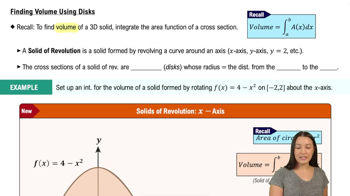
Finding Volume Using Disks

Riemann Sums (Left, Right, Midpoint)

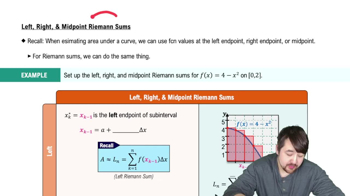
Riemann sums approximate the value of an integral by summing areas of rectangles under a curve. Left sums use the function value at the left endpoint of each subinterval, right sums use the right endpoint, and midpoint sums use the midpoint. These methods provide estimates for the volume when exact integration is difficult.
Video consigliato:
Percorso guidato
07:39
Left, Right, & Midpoint Riemann Sums

Volume Approximation Using Disk Method

The disk method calculates the volume of a solid of revolution by summing volumes of thin disks perpendicular to the axis of rotation. Each disk's volume is π[f(x)]²Δx, where f(x) is the radius. Using Riemann sums with these disk volumes approximates the total volume of the solid.
Video consigliato:
04:48
Finding Volume Using Disks