

Ch. 6 - Applications of Integration
Briggs - Calculus: Early Transcendentals 3rd Edition
Briggs3rd EditionCalculus: Early TranscendentalsISBN: 9780136847243Non è quello che usi tu?Cambia libro di testo
Capitolo 6, Problema 6.1.25c

Flying into a headwind The velocity (in mi/hr) of an airplane flying into a headwind is given by v(t) = 30(16−t²), for 0≤t≤3. Assume s(0)=0 and t is measured in hours.


c. How far has the airplane traveled at the instant its velocity reaches 400 mi/hr?

Guida verificata passo dopo passo
1
First, understand that the velocity function is given by \(v(t) = 30(16 - t^{2})\), where \(t\) is time in hours and \(v(t)\) is velocity in miles per hour. We want to find the distance traveled when the velocity reaches 400 mi/hr.
Set the velocity equal to 400 and solve for \(t\): \(30(16 - t^{2}) = 400\). This will give the time(s) at which the velocity is 400 mi/hr.
Solve the equation for \(t\): divide both sides by 30 to isolate the quadratic term, then rearrange to form a quadratic equation and solve for \(t\).
Once you find the appropriate value of \(t\) within the interval \(0 \leq t \leq 3\), use the position function \(s(t)\) to find the distance traveled. Since velocity is the derivative of position, \(s(t) = \int v(t) \, dt + s(0)\).
Integrate \(v(t) = 30(16 - t^{2})\) with respect to \(t\) to find \(s(t)\), then substitute the value of \(t\) found earlier into \(s(t)\) to find the distance traveled at that instant.

Risposta video verificata per un problema simile:

Questa soluzione video è stata consigliata dai nostri tutor come utile per risolvere questo problema.
Durata del video:
4m

Concetti chiave

Ecco i concetti essenziali che devi comprendere per rispondere correttamente alla domanda.

Velocity and Position Relationship

Velocity is the rate of change of position with respect to time. To find the distance traveled, you integrate the velocity function over the given time interval. Here, s(t) represents the position, and its derivative s'(t) equals the velocity v(t).
Video consigliato:
Percorso guidato
06:29
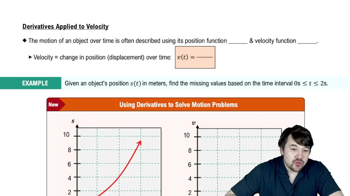
Derivatives Applied To Velocity

Solving for Time from Velocity

To find when the velocity reaches a specific value, set the velocity function equal to that value and solve for time t. This step is crucial to determine the exact instant at which the airplane's velocity is 400 mi/hr.
Video consigliato:
Percorso guidato
10:17
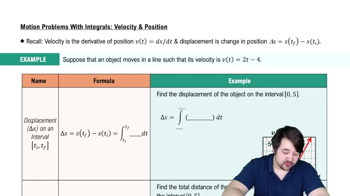
Using The Velocity Function

Definite Integration for Displacement

Once the time t is found, calculate the distance traveled by integrating the velocity function from the initial time to t. This definite integral gives the total displacement, which is the airplane's traveled distance at that instant.
Video consigliato:
Percorso guidato
05:43
Definition of the Definite Integral
Pratica correlata
Domanda del libro di testo

Bike race Theo and Sasha start at the same place on a straight road, riding bikes with the following velocities (measured in mi/hr). Assume t is measured in hours.

Theo: vT(t)=10, for t≥0

Sasha: vS(t)=15t, for 0≤t≤1, and vS(t)=15, for t>1


c. If the riders ride for 2 hr, who rides farther? Interpret your answer geometrically using the graphs of part (a). 

33
views
Domanda del libro di testo

9–10. Velocity graphs The figures show velocity functions for motion along a line. Assume the motion begins with an initial position of s(0)=0. Determine the following.

d. A piecewise function for s(t)

89
views
Domanda del libro di testo

Cycling distance A cyclist rides down a long straight road with a velocity (in m/min) given by v(t) = 400−20t, for 0≤t≤10, where t is measured in minutes.


c. How far has the cyclist traveled when her velocity is 250 m/min?

49
views
Domanda del libro di testo

9–10. Velocity graphs The figures show velocity functions for motion along a line. Assume the motion begins with an initial position of s(0)=0. Determine the following.

d. A piecewise function for s(t)

54
views
Domanda del libro di testo

Day hike The velocity (in mi/hr) of a hiker walking along a straight trail is given by v(t) = 3 sin² πt/2, for 0≤t≤4. Assume s(0)=0 and t is measured in hours. 


c. What is the hiker’s position at t=3?

51
views
Domanda del libro di testo

13–16. Displacement from velocity Consider an object moving along a line with the given velocity v. Assume time t is measured in seconds and velocities have units of m/s.


c. Find the distance traveled over the given interval.


v(t) = 3t²−6t on [0, 3]

85
views