

Ch. 6 - Applications of Integration
Briggs - Calculus: Early Transcendentals 3rd Edition
Briggs3rd EditionCalculus: Early TranscendentalsISBN: 9780136847243Non è quello che usi tu?Cambia libro di testo
Capitolo 6, Problema 6.1.45a

Oil production An oil refinery produces oil at a variable rate given by Q'(t) = <1x3 matrix>, where is measured in days and is measured in barrels. 


a. How many barrels are produced in the first 35 days?

Guida verificata passo dopo passo
1
Identify the given rate of oil production function, which is the derivative of the quantity produced, denoted as \(Q'(t)\). This function represents the rate of change of barrels produced per day.
To find the total barrels produced in the first 35 days, set up the definite integral of the rate function \(Q'(t)\) from \(t=0\) to \(t=35\). This integral will give the total quantity produced over that time interval.
Write the integral as \(\int_0^{35} Q'(t) \, dt\). This represents the accumulation of production from day 0 to day 35.
Evaluate the integral by finding the antiderivative \(Q(t)\) of \(Q'(t)\), then compute \(Q(35) - Q(0)\) to find the total barrels produced in the first 35 days.
Interpret the result as the total number of barrels produced during the first 35 days, based on the integral of the production rate.

Risposta video verificata per un problema simile:

Questa soluzione video è stata consigliata dai nostri tutor come utile per risolvere questo problema.
Durata del video:
2m

Concetti chiave

Ecco i concetti essenziali che devi comprendere per rispondere correttamente alla domanda.

Derivative as a Rate of Change

The derivative Q'(t) represents the instantaneous rate of oil production at time t, measured in barrels per day. Understanding that the derivative gives the rate at which the quantity changes is essential to relate production rate to total production.
Video consigliato:
Percorso guidato
04:16
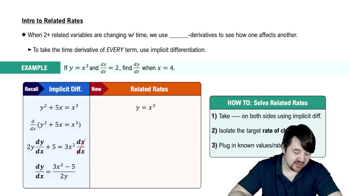
Intro To Related Rates

Definite Integral for Accumulated Quantity

The total barrels produced over a time interval is found by integrating the rate function Q'(t) over that interval. The definite integral sums the instantaneous rates to give the accumulated quantity produced between two time points.
Video consigliato:
Percorso guidato
05:43
Definition of the Definite Integral

Evaluating Definite Integrals

To find the total production in the first 35 days, you must evaluate the definite integral of Q'(t) from t=0 to t=35. This involves finding the antiderivative of Q'(t) and computing the difference of its values at the limits.
Video consigliato:
Percorso guidato
05:43
Definition of the Definite Integral
Pratica correlata
Domanda del libro di testo

Consider a solid whose base is the region in the first quadrant bounded by the curve y=√3−x and the line x=2, and whose cross sections through the solid perpendicular to the x-axis are squares.


a. Find an expression for the area A(x) of a cross section of the solid at a point x in [0, 2].

100
views
Domanda del libro di testo

Oscillating growth rates Some species have growth rates that oscillate with an (approximately) constant period P. Consider the growth rate function N'(t) = r+A sin 2πt/P, where A and r are constants with units of individuals/yr, and t is measured in years. A species becomes extinct if its population ever reaches 0 after t=0.


a. Suppose P=10, A=20, and r=0. If the initial population is N(0)=10, does the population ever become extinct? Explain.

51
views
Domanda del libro di testo

Filling a tank A 2000-liter cistern is empty when water begins flowing into it (at t=0 at a rate (in L/min) given by Q′(t) = 3√t, where t is measured in minutes.


a. How much water flows into the cistern in 1 hour?

68
views
Domanda del libro di testo

Winding a chain A 30-m-long chain hangs vertically from a cylinder attached to a winch. Assume there is no friction in the system and the chain has a density of 5kg/m.

a. How much work is required to wind the entire chain onto the cylinder using the winch?

64
views
Domanda del libro di testo

Work in a gravitational field For large distances from the surface of Earth, the gravitational force is given by F(x) = GMm / (x+R)², where G = 6.7×10^−11 N m²/kg² is the gravitational constant, M = 6×10^24 kg is the mass of Earth, m is the mass of the object in the gravitational field, R = 6.378×10⁶ m is the radius of Earth, and x≥0 is the distance above the surface of Earth (in meters).


a. How much work is required to launch a rocket with a mass of 500 kg in a vertical flight path to a height of 2500 km (from Earth’s surface)?

73
views
Domanda del libro di testo

Determine whether the following statements are true and give an explanation or counterexample.


a. The area of the region bounded by y=x and x=y^2 can be found only by integrating with respect to x.

53
views