
Ch. 6 - Applications of Integration
Briggs - Calculus: Early Transcendentals 3rd Edition
Briggs3rd EditionCalculus: Early TranscendentalsISBN: 9780136847243Non è quello che usi tu?Cambia libro di testo
Capitolo 6, Problema 6.3.3a

Consider a solid whose base is the region in the first quadrant bounded by the curve y=√3−x and the line x=2, and whose cross sections through the solid perpendicular to the x-axis are squares.


a. Find an expression for the area A(x) of a cross section of the solid at a point x in [0, 2].

Guida verificata passo dopo passo
1
Identify the region that forms the base of the solid. The base lies in the first quadrant bounded by the curve \(y = \sqrt{3} - x\) and the vertical line \(x = 2\). Since we are in the first quadrant, \(x\) ranges from 0 to 2, and \(y\) is non-negative.
Understand the shape of the cross sections. The problem states that cross sections perpendicular to the x-axis are squares. This means that at each fixed \(x\), the cross section is a square whose side length corresponds to the vertical distance between the curve and the x-axis.
Determine the side length of the square at a given \(x\). Since the base is bounded below by the x-axis (\(y=0\)) and above by the curve \(y = \sqrt{3} - x\), the side length \(s(x)\) of the square at position \(x\) is the height of the region, which is \(s(x) = \sqrt{3} - x\).
Write the formula for the area of the square cross section at \(x\). The area \(A(x)\) of a square with side length \(s(x)\) is \(A(x) = [s(x)]^2\).
Substitute the expression for \(s(x)\) into the area formula to get \(A(x) = (\sqrt{3} - x)^2\) for \(x\) in the interval \([0, 2]\).

Risposta video verificata per un problema simile:

Questa soluzione video è stata consigliata dai nostri tutor come utile per risolvere questo problema.
Durata del video:
2m

Concetti chiave

Ecco i concetti essenziali che devi comprendere per rispondere correttamente alla domanda.

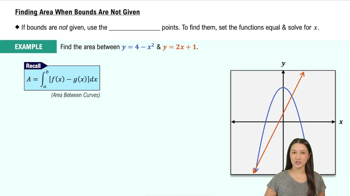
Region Bounded by Curves

Understanding the region bounded by the curve y = √(3 - x) and the line x = 2 in the first quadrant is essential. This involves identifying the domain of x-values and the corresponding y-values that define the base of the solid, which sets the limits for integration or cross-sectional analysis.
Video consigliato:
05:06
Finding Area When Bounds Are Not Given

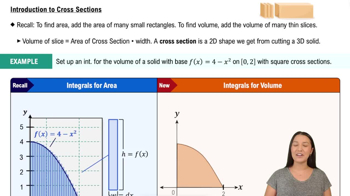
Cross Sections Perpendicular to the x-axis

Cross sections perpendicular to the x-axis mean slicing the solid at a fixed x-value to examine the shape and size of the cross section. Here, each cross section is a square, so the side length depends on the y-values of the base region at that x, which determines the area function A(x).
Video consigliato:
05:38
Introduction to Cross Sections

Area of a Square Cross Section

Since the cross sections are squares, the area A(x) is the square of the side length. The side length corresponds to the vertical distance between the curve and the x-axis at a given x, so A(x) = (side length)^2. Calculating this expression is key to finding the area function.
Video consigliato:
05:38
Introduction to Cross Sections