Ch. 6 - Applications of Integration
Briggs - Calculus: Early Transcendentals 3rd Edition
Briggs3rd EditionCalculus: Early TranscendentalsISBN: 9780136847243Non è quello che usi tu?Cambia libro di testo
Capitolo 6, Problema 6.R.77b

Pumping water A water tank has the shape of a box that is 2 m wide, 4 m long, and 6 m high.


b. If the water in the tank is 2 m deep, how much work is required to pump the water to a level of 1 m above the top of the tank?

Guida verificata passo dopo passo
1
First, identify the dimensions of the tank and the depth of the water. The tank is 2 m wide, 4 m long, and 6 m high. The water depth is 2 m.
Set up a coordinate system to represent the height of the water. Let \( y = 0 \) be at the bottom of the tank and \( y = 6 \) be at the top. The water occupies from \( y = 0 \) to \( y = 2 \).
Consider a thin horizontal slice of water at height \( y \) with thickness \( dy \). The volume of this slice is the area of the base times the thickness: \( dV = (2 \times 4) dy = 8 dy \) cubic meters.
Calculate the weight of this slice. Since the density of water is \( \rho = 1000 \, \text{kg/m}^3 \) and gravitational acceleration is \( g = 9.8 \, \text{m/s}^2 \), the weight is \( dW = \rho g dV = 1000 \times 9.8 \times 8 dy = 78400 dy \) newtons.
Determine the distance the slice must be lifted. The water must be pumped to 1 m above the top of the tank, so the lifting height for the slice at height \( y \) is \( (6 + 1) - y = 7 - y \) meters.
Set up the integral for the work done to pump all the water: \[ W = \int_0^2 \text{(weight of slice)} \times \text{(distance lifted)} \, dy = \int_0^2 78400 (7 - y) dy. \] This integral represents the total work required.

Risposta video verificata per un problema simile:

Questa soluzione video è stata consigliata dai nostri tutor come utile per risolvere questo problema.
Durata del video:
7m

Concetti chiave

Ecco i concetti essenziali che devi comprendere per rispondere correttamente alla domanda.

Work Done by a Variable Force

Work is calculated as the integral of force over distance when the force varies. In pumping water, the force depends on the weight of each water layer, and the distance varies with depth, requiring integration to sum the work done on all layers.
Video consigliato:
Percorso guidato
05:40
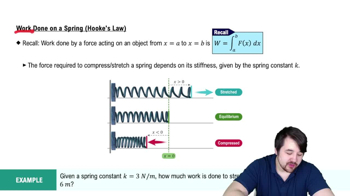
Work Done On A Spring (Hooke's Law)

Volume and Weight of Water

The volume of water is found by multiplying the tank's cross-sectional area by the water depth. The weight is then calculated by multiplying the volume by the density of water and gravitational acceleration, which gives the force needed to move the water.
Video consigliato:
04:48
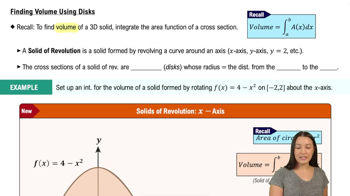
Finding Volume Using Disks

Setting up the Integral for Work

To find the total work, divide the water into thin horizontal slices, calculate the work to lift each slice to the target height, and integrate over the depth of the water. This involves expressing the distance each slice is lifted as a function of its depth.
Video consigliato:
Percorso guidato
06:22
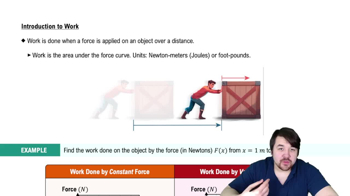
Introduction To Work