Ch. 7 - Logarithmic, Exponential Functions, and Hyperbolic Functions
Briggs - Calculus: Early Transcendentals 3rd Edition
Briggs3rd EditionCalculus: Early TranscendentalsISBN: 9780136847243Non è quello che usi tu?Cambia libro di testo
Capitolo 7, Problema 7.R.10

10–19. Derivatives Find the derivatives of the following functions.
f(x) = ln(3 sin² 4x)

Guida verificata passo dopo passo
1
Recognize that the function is a composition of functions: \(f(x) = \ln(3 \sin^{2}(4x))\). We will need to use the chain rule and properties of logarithms to differentiate it.
Use the logarithm property to simplify the function before differentiating: \(\ln(3 \sin^{2}(4x)) = \ln(3) + \ln(\sin^{2}(4x)) = \ln(3) + 2 \ln(\sin(4x))\). Since \(\ln(3)\) is a constant, its derivative is zero.
Focus on differentiating \(2 \ln(\sin(4x))\). Apply the constant multiple rule: the derivative is \(2\) times the derivative of \(\ln(\sin(4x))\).
Differentiate \(\ln(\sin(4x))\) using the chain rule: the derivative of \(\ln(u)\) is \(\frac{1}{u} \cdot \frac{du}{dx}\). Here, \(u = \sin(4x)\), so \(\frac{du}{dx} = \cos(4x) \cdot 4\) by the chain rule.
Combine all parts to write the derivative: \(f'(x) = 2 \cdot \frac{1}{\sin(4x)} \cdot \cos(4x) \cdot 4\). Simplify this expression as much as possible to get the final derivative.

Risposta video verificata per un problema simile:

Questa soluzione video è stata consigliata dai nostri tutor come utile per risolvere questo problema.
Durata del video:
4m

Concetti chiave

Ecco i concetti essenziali che devi comprendere per rispondere correttamente alla domanda.

Chain Rule

The chain rule is used to differentiate composite functions by taking the derivative of the outer function evaluated at the inner function and multiplying it by the derivative of the inner function. For example, if y = f(g(x)), then dy/dx = f'(g(x)) * g'(x). This rule is essential when differentiating functions like ln(3 sin² 4x), which involve nested functions.
Video consigliato:
05:02
Intro to the Chain Rule

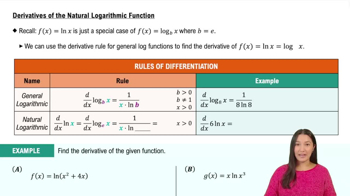
Derivative of the Natural Logarithm Function

The derivative of ln(u), where u is a differentiable function of x, is (1/u) * du/dx. This means you first find the derivative of the inside function u and then divide by u itself. This property simplifies differentiating logarithmic functions such as ln(3 sin² 4x).
Video consigliato:
05:18
Derivative of the Natural Logarithmic Function

Derivative of Trigonometric Functions and Power Rule

To differentiate expressions like sin²(4x), you apply the power rule and the chain rule together. The power rule states that d/dx [u^n] = n u^(n-1) du/dx, and the derivative of sin(4x) involves the chain rule: cos(4x) * 4. Combining these helps find the derivative of sin²(4x).
Video consigliato:
06:35
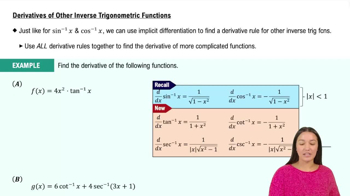
Derivatives of Other Inverse Trigonometric Functions
Pratica correlata
Domanda del libro di testo

Linear approximation Find the linear approximation to ƒ(x) = cosh x at a = ln 3 and then use it to approximate the value of cosh 1.

51
views

Domanda del libro di testo

Log-normal probability distribution A commonly used distribution in probability and statistics is the log-normal distribution. (If the logarithm of a variable has a normal distribution, then the variable itself has a log-normal distribution.) The distribution function is

f(x) = 1/xσ√(2π) e⁻ˡⁿ^² ˣ / ²σ^², for x ≥ 0

where ln x has zero mean and standard deviation σ > 0.

e. For what value of σ > 0 in part (d) does ƒ(x*) have a minimum?

80
views
Domanda del libro di testo

Limit Evaluate lim x → ∞ (tanh x)ˣ.

104
views
Domanda del libro di testo

Log-normal probability distribution A commonly used distribution in probability and statistics is the log-normal distribution. (If the logarithm of a variable has a normal distribution, then the variable itself has a log-normal distribution.) The distribution function is

f(x) = 1/xσ√(2π) e⁻ˡⁿ^² ˣ / ²σ^², for x ≥ 0

where ln x has zero mean and standard deviation σ > 0.

b. Evaluate lim x → 0 ƒ(x). (Hint: Let x = eʸ.)

92
views
Domanda del libro di testo

27–28. Curve sketching Use the graphing techniques of Section 4.4 to graph the following functions on their domains. Identify local extreme points, inflection points, concavity, and end behavior. Use a graphing utility only to check your work.

f(x) = ln x – ln² x

69
views
Domanda del libro di testo

10–19. Derivatives Find the derivatives of the following functions.

f(x) = (sinh x) / (1 + sinh x)

60
views