Ch. 7 - Logarithmic, Exponential Functions, and Hyperbolic Functions
Briggs - Calculus: Early Transcendentals 3rd Edition
Briggs3rd EditionCalculus: Early TranscendentalsISBN: 9780136847243Non è quello che usi tu?Cambia libro di testo
Capitolo 7, Problema 7.R.29e

Log-normal probability distribution A commonly used distribution in probability and statistics is the log-normal distribution. (If the logarithm of a variable has a normal distribution, then the variable itself has a log-normal distribution.) The distribution function is
f(x) = 1/xσ√(2π) e⁻ˡⁿ^² ˣ / ²σ^², for x ≥ 0
where ln x has zero mean and standard deviation σ > 0.
e. For what value of σ > 0 in part (d) does ƒ(x*) have a minimum?

Guida verificata passo dopo passo
1
First, write down the given probability density function (pdf) of the log-normal distribution: \(f(x) = \frac{1}{x \sigma \sqrt{2\pi}} e^{-\frac{(\ln x)^2}{2 \sigma^2}}\), for \(x \geq 0\).
Identify the variable with respect to which you want to find the minimum of \(f(x^*)\). Here, $x^*$ is fixed, and you want to find the value of \(\sigma > 0\) that minimizes \(f(x^*)\).
Treat \(f(x^*)\) as a function of \(\sigma\) only: \(f(\sigma) = \frac{1}{x^* \sigma \sqrt{2\pi}} e^{-\frac{(\ln x^*)^2}{2 \sigma^2}}\).
To find the minimum, compute the derivative of \(f(\sigma)\) with respect to \(\sigma\), denoted \(f'(\sigma)\), using the product and chain rules. Remember to differentiate both the \(1/\sigma\) term and the exponential term.
Set the derivative \(f'(\sigma) = 0\) and solve for \(\sigma > 0\). This will give the critical points. Then, verify which critical point corresponds to a minimum by checking the second derivative or analyzing the behavior of \(f(\sigma)\).

Risposta video verificata per un problema simile:

Questa soluzione video è stata consigliata dai nostri tutor come utile per risolvere questo problema.
Durata del video:
8m

Concetti chiave

Ecco i concetti essenziali che devi comprendere per rispondere correttamente alla domanda.

Log-normal Distribution

A log-normal distribution describes a random variable whose logarithm is normally distributed. If ln(X) follows a normal distribution with mean μ and standard deviation σ, then X is log-normally distributed. This distribution is skewed right and only defined for positive values, commonly used in modeling multiplicative processes.
Video consigliato:
2:51
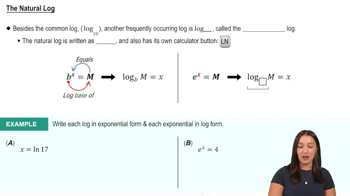
The Natural Log

Probability Density Function (PDF)

The PDF of a continuous random variable gives the relative likelihood of the variable taking a specific value. For the log-normal distribution, the PDF involves the variable x, its logarithm, and parameters like σ. Understanding the PDF's form is essential to analyze properties such as maxima, minima, and moments.
Video consigliato:
Percorso guidato
06:21
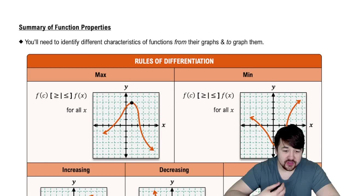
Properties of Functions

Optimization of Functions with Respect to Parameters

Finding the minimum or maximum of a function with respect to a parameter involves taking derivatives and solving for critical points. In this context, determining the value of σ that minimizes ƒ(x*) requires differentiating the PDF with respect to σ and analyzing the resulting conditions.
Video consigliato:
10:13
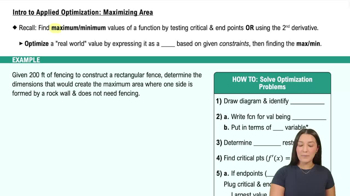
Intro to Applied Optimization: Maximizing Area