Ch. 7 - Logarithmic, Exponential Functions, and Hyperbolic Functions
Briggs - Calculus: Early Transcendentals 3rd Edition
Briggs3rd EditionCalculus: Early TranscendentalsISBN: 9780136847243Non è quello che usi tu?Cambia libro di testo
Capitolo 7, Problema 7.2.29

27–30. Designing exponential decay functions Devise an exponential decay function that fits the following data; then answer the accompanying questions. Be sure to identify the reference point (t = 0) and units of time.


Valium metabolism The drug Valium is eliminated from the bloodstream with a half-life of 36 hr. Suppose a patient receives an initial dose of 20 mg of Valium at midnight. How much Valium is in the patient’s blood at noon the next day? When will the Valium concentration reach 10% of its initial level?

Guida verificata passo dopo passo
1
Identify the general form of the exponential decay function, which is given by \(C(t) = C_0 \cdot e^{-kt}\), where \(C(t)\) is the concentration at time \(t\), \(C_0\) is the initial concentration, and \(k\) is the decay constant.
Determine the reference point and units: here, \(t=0\) corresponds to midnight when the initial dose of 20 mg is administered, and time \(t\) is measured in hours.
Use the half-life information to find the decay constant \(k\). Since the half-life \(T_{1/2} = 36\) hours, apply the formula \(\frac{1}{2} = e^{-kT_{1/2}}\), which can be rewritten as \(k = \frac{\ln(2)}{T_{1/2}}\).
Calculate the amount of Valium in the bloodstream at noon the next day, which is 12 hours after midnight, by substituting \(t=12\) into the decay function: \(C(12) = 20 \cdot e^{-k \cdot 12}\).
To find when the concentration reaches 10% of the initial dose, set \(C(t) = 0.1 \times 20\) and solve for \(t\) using the equation \(0.1 \times 20 = 20 \cdot e^{-kt}\), which simplifies to \(0.1 = e^{-kt}\). Taking the natural logarithm of both sides gives \(t = -\frac{\ln(0.1)}{k}\).

Risposta video verificata per un problema simile:

Questa soluzione video è stata consigliata dai nostri tutor come utile per risolvere questo problema.
Durata del video:
3m

Concetti chiave

Ecco i concetti essenziali che devi comprendere per rispondere correttamente alla domanda.

Exponential Decay Function

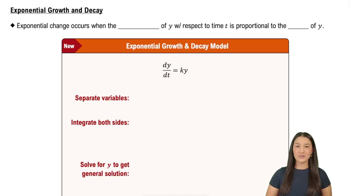
An exponential decay function models quantities that decrease at a rate proportional to their current value. It is generally expressed as N(t) = N_0 * e^(-kt), where N_0 is the initial amount, k is the decay constant, and t is time. This function is essential for describing processes like drug elimination from the bloodstream.
Video consigliato:
09:29
Exponential Growth & Decay

Half-Life and Decay Constant Relationship

The half-life is the time required for a quantity to reduce to half its initial value. It relates to the decay constant k by the formula k = ln(2) / half-life. Understanding this relationship allows conversion between half-life and the decay rate used in the exponential decay function.
Video consigliato:
09:29
Exponential Growth & Decay

Reference Point and Time Units

Defining the reference point (t = 0) and consistent time units is crucial for correctly applying the decay function. In this problem, t = 0 corresponds to midnight when the dose is administered, and time is measured in hours. This ensures accurate calculation of drug concentration at any given time.
Video consigliato:
5:10
Evaluate Composite Functions - Values on Unit Circle