Ch. 7 - Logarithmic, Exponential Functions, and Hyperbolic Functions
Briggs - Calculus: Early Transcendentals 3rd Edition
Briggs3rd EditionCalculus: Early TranscendentalsISBN: 9780136847243Non è quello che usi tu?Cambia libro di testo
Capitolo 7, Problema 7.1.10

7–28. Derivatives Evaluate the following derivatives.


d/dx (ln (cos² x))

Guida verificata passo dopo passo
1
Step 1: Recognize that the derivative involves the natural logarithm function ln and the cosine squared function cos²(x). Use the chain rule and logarithmic differentiation to simplify the process.
Step 2: Apply the logarithmic property ln(a^b) = b * ln(a) to rewrite ln(cos²(x)) as 2 * ln(cos(x)). This simplifies the expression and makes differentiation easier.
Step 3: Differentiate the simplified expression 2 * ln(cos(x)) with respect to x. The constant 2 remains unchanged, and you focus on differentiating ln(cos(x)).
Step 4: Use the chain rule to differentiate ln(cos(x)). The derivative of ln(u) is 1/u, and the derivative of cos(x) is -sin(x). Combine these to get (1/cos(x)) * (-sin(x)).
Step 5: Multiply the result from Step 4 by the constant 2 from Step 3. The final derivative is -2 * (sin(x)/cos(x)), which can also be expressed as -2 * tan(x).

Risposta video verificata per un problema simile:

Questa soluzione video è stata consigliata dai nostri tutor come utile per risolvere questo problema.
Durata del video:
1m

Concetti chiave

Ecco i concetti essenziali che devi comprendere per rispondere correttamente alla domanda.

Derivatives

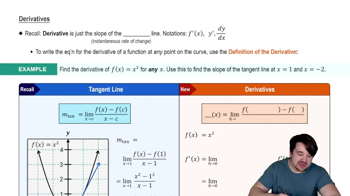
A derivative represents the rate of change of a function with respect to a variable. In calculus, it is a fundamental concept that allows us to determine how a function behaves at any given point. The derivative is often denoted as f'(x) or dy/dx, and it can be interpreted as the slope of the tangent line to the curve of the function at a specific point.
Video consigliato:

Chain Rule

The chain rule is a formula for computing the derivative of the composition of two or more functions. It states that if you have a function g(x) that is composed with another function f(u), where u = g(x), then the derivative of f with respect to x can be found by multiplying the derivative of f with respect to u by the derivative of g with respect to x. This is essential for differentiating complex functions like ln(cos² x).
Video consigliato:
05:02
Intro to the Chain Rule

Logarithmic Differentiation

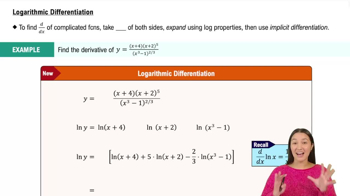
Logarithmic differentiation is a technique used to differentiate functions that are products or quotients of variables, especially when they involve exponentials or logarithms. By taking the natural logarithm of both sides of an equation, we can simplify the differentiation process. This method is particularly useful for functions like ln(cos² x), as it allows us to apply the properties of logarithms to simplify the expression before differentiating.
Video consigliato:
06:30
Logarithmic Differentiation
Pratica correlata
Domanda del libro di testo

29–62. Integrals Evaluate the following integrals. Include absolute values only when needed.


∫ e^{2x} / (4 + e^{2x}) dx

54
views

Domanda del libro di testo

Derivative of ln|x| Differentiate ln x, for x > 0, and differentiate ln(−x), for x < 0, to conclude that d/dx (ln|x|) = 1/x

194
views
Domanda del libro di testo

27–30. Designing exponential decay functions Devise an exponential decay function that fits the following data; then answer the accompanying questions. Be sure to identify the reference point (t = 0) and units of time.


Valium metabolism The drug Valium is eliminated from the bloodstream with a half-life of 36 hr. Suppose a patient receives an initial dose of 20 mg of Valium at midnight. How much Valium is in the patient’s blood at noon the next day? When will the Valium concentration reach 10% of its initial level?

64
views
Domanda del libro di testo

A calculator has a built-in sinh⁻¹ x function, but no csch⁻¹ x function. How do you evaluate csch⁻¹ 5 on such a calculator?

52
views
Domanda del libro di testo

37–56. Integrals Evaluate each integral.

∫ (cosh z) / (sinh² z) dz

51
views
Domanda del libro di testo

15–20. Designing exponential growth functions Complete the following steps for the given situation.


a. Find the rate constant k and use it to devise an exponential growth function that fits the given data.

b. Answer the accompanying question.


Cell growth The number of cells in a tumor doubles every 6 weeks starting with 8 cells. After how many weeks does the tumor have 1500 cells?

38
views