Ch. 7 - Logarithmic, Exponential Functions, and Hyperbolic Functions
Briggs - Calculus: Early Transcendentals 3rd Edition
Briggs3rd EditionCalculus: Early TranscendentalsISBN: 9780136847243Non è quello che usi tu?Cambia libro di testo
Capitolo 7, Problema 7.1.59

29–62. Integrals Evaluate the following integrals. Include absolute values only when needed.


∫₀ˡⁿ ² (e^{3x} − e^{−3x}) / (e^{3x} + e^{−3x}) dx

Guida verificata passo dopo passo
1
Recognize that the integral involves the expression \( \frac{e^{3x} - e^{-3x}}{e^{3x} + e^{-3x}} \), which resembles the hyperbolic tangent function \( \tanh(u) = \frac{e^{u} - e^{-u}}{e^{u} + e^{-u}} \). Here, identify \( u = 3x \).
Rewrite the integral using the substitution: \( \frac{e^{3x} - e^{-3x}}{e^{3x} + e^{-3x}} = \tanh(3x) \). So the integral becomes \( \int_0^{\ln 2} \tanh(3x) \, dx \).
Use substitution to simplify the integral: let \( t = 3x \), then \( dt = 3 \, dx \) or \( dx = \frac{dt}{3} \). Change the limits accordingly: when \( x=0 \), \( t=0 \); when \( x=\ln 2 \), \( t=3 \ln 2 \).
Rewrite the integral in terms of \( t \): \( \int_0^{3 \ln 2} \tanh(t) \cdot \frac{1}{3} \, dt = \frac{1}{3} \int_0^{3 \ln 2} \tanh(t) \, dt \).
Recall the integral formula for hyperbolic tangent: \( \int \tanh(t) \, dt = \ln|\cosh(t)| + C \). Use this to write the antiderivative and then apply the limits to express the definite integral.

Risposta video verificata per un problema simile:

Questa soluzione video è stata consigliata dai nostri tutor come utile per risolvere questo problema.
Durata del video:
3m

Concetti chiave

Ecco i concetti essenziali che devi comprendere per rispondere correttamente alla domanda.

Integration of Rational Functions Involving Exponentials

This concept involves integrating functions where exponentials appear in both numerator and denominator, often requiring algebraic manipulation or substitution to simplify the integrand. Recognizing patterns such as hyperbolic functions can help rewrite the integral in a more manageable form.
Video consigliato:
05:11
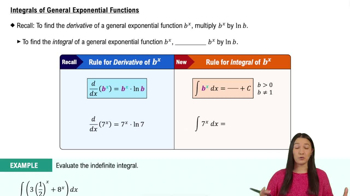
Integrals of General Exponential Functions

Hyperbolic Functions and Their Properties

The given integrand resembles the hyperbolic tangent function, tanh(x) = (e^x - e^{-x}) / (e^x + e^{-x}). Understanding hyperbolic functions and their derivatives is essential, as it allows rewriting the integral in terms of tanh(3x), simplifying the integration process.
Video consigliato:
Percorso guidato
06:21
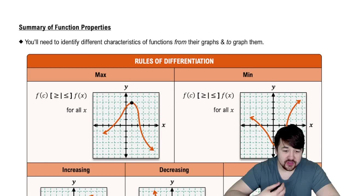
Properties of Functions

Definite Integration and Evaluation of Limits

After finding the antiderivative, evaluating the definite integral requires substituting the upper and lower limits correctly. Attention to the domain and the presence of absolute values ensures the correct evaluation of the integral, especially when dealing with logarithmic or inverse hyperbolic functions.
Video consigliato:
Percorso guidato
05:43
Definition of the Definite Integral