
Uranium dating Uranium-238 (U-238) has a half-life of 4.5 billion years. Geologists find a rock containing a mixture of U-238 and lead, and they determine that 85% of the original U-238 remains; the other 15% has decayed into lead. How old is the rock?
Ch. 7 - Logarithmic, Exponential Functions, and Hyperbolic Functions
Briggs3rd EditionCalculus: Early TranscendentalsISBN: 9780136847243Non è quello che usi tu?Cambia libro di testo
Tutti i libri di testo
Briggs 3rd Edition
Ch. 7 - Logarithmic, Exponential Functions, and Hyperbolic Functions
Problema 7.1.5
Briggs 3rd Edition
Ch. 7 - Logarithmic, Exponential Functions, and Hyperbolic Functions
Problema 7.1.5Capitolo 7, Problema 7.1.5
Express 3ˣ, x^{π}, and x^{sin x} using the base e.
Guida verificata passo dopo passo1
Recall that any exponential expression with base \(a\) can be rewritten using the natural exponential function \(e\) as \(a^{b} = e^{b \ln a}\). This is because \(e^{\ln a} = a\).
For the expression \(3^{x}\), apply the formula by setting \(a = 3\) and \(b = x\). This gives \(3^{x} = e^{x \ln 3}\).
For the expression \(x^{\pi}\), treat \(x\) as the base and \(\pi\) as the exponent. Using the same formula, \(x^{\pi} = e^{\pi \ln x}\).
For the expression \(x^{\sin x}\), the exponent is a function of \(x\). Apply the formula with \(a = x\) and \(b = \sin x\), resulting in \(x^{\sin x} = e^{\sin x \cdot \ln x}\).
Summarize the results: \(3^{x} = e^{x \ln 3}\), \(x^{\pi} = e^{\pi \ln x}\), and \(x^{\sin x} = e^{\sin x \ln x}\). These forms express the original functions using the base \(e\).

Risposta video verificata per un problema simile:
Questa soluzione video è stata consigliata dai nostri tutor come utile per risolvere questo problema.
Durata del video:
2mConcetti chiave
Ecco i concetti essenziali che devi comprendere per rispondere correttamente alla domanda.
Exponential Functions and the Natural Base e
Exponential functions with base e are expressed as e raised to a power. The number e (~2.718) is the natural base for logarithms and exponentials, simplifying many calculus operations. Any exponential expression a^x can be rewritten as e^(x ln a), linking arbitrary bases to base e.
Video consigliato:
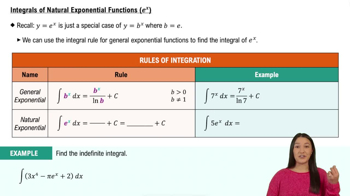
Integrals of Natural Exponential Functions (e^x)
Natural Logarithm (ln) and its Properties
The natural logarithm ln(x) is the inverse of the exponential function e^x. It allows conversion between different exponential bases by using the identity a^x = e^(x ln a). Understanding ln is essential for rewriting expressions with bases other than e.
Video consigliato:
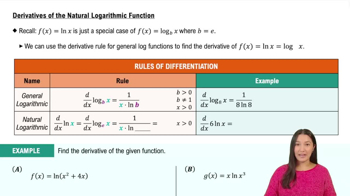
Derivative of the Natural Logarithmic Function
Handling Variable Exponents in Exponential Expressions
When the exponent itself is a function of x, such as x^{sin x}, rewriting with base e involves expressing the power as e raised to the product of the exponent function and the natural logarithm of the base. This approach generalizes to variable exponents and is key for differentiation and integration.
Video consigliato:
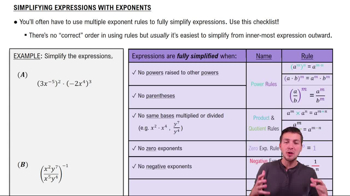
Simplifying Exponential Expressions
Pratica correlata
Domanda del libro di testo
142
views
Domanda del libro di testo
29–62. Integrals Evaluate the following integrals. Include absolute values only when needed.
∫₀ˡⁿ ² (e^{3x} − e^{−3x}) / (e^{3x} + e^{−3x}) dx
61
views
Domanda del libro di testo
What is the inverse function of ln x, and what are its domain and range?
262
views
Domanda del libro di testo
Arc length Use the result of Exercise 108 to find the arc length of the curve: f(x) = ln |tanh(x / 2)| on [ln 2, ln 8].
44
views
Domanda del libro di testo
37–56. Integrals Evaluate each integral.
∫ sinh x / (1 + cosh x) dx
69
views
Domanda del libro di testo
13–14. Absolute and relative growth rates Two functions f and g are given. Show that the growth rate of the linear function is constant and the relative growth rate of the exponential function is constant.
f(t) = 100 + 10.5t, g(t) = 100e^(t/10)
71
views