Ch. 7 - Logarithmic, Exponential Functions, and Hyperbolic Functions
Briggs - Calculus: Early Transcendentals 3rd Edition
Briggs3rd EditionCalculus: Early TranscendentalsISBN: 9780136847243Non è quello che usi tu?Cambia libro di testo
Capitolo 7, Problema 7.1.35

29–62. Integrals Evaluate the following integrals. Include absolute values only when needed.


∫ₑᵉ^³ dx / (x ln x ln²(ln x))

Guida verificata passo dopo passo
1
Identify the integral to be evaluated: \(\int_{e}^{e^{3}} \frac{dx}{x \ln x \left(\ln(\ln x)\right)^2}\).
Recognize that the integrand contains nested logarithmic functions, suggesting a substitution involving \(\ln x\) or \(\ln(\ln x)\).
Let \(u = \ln(\ln x)\). Then, compute \(du\) in terms of \(dx\): first, note that \(\ln x\) is inside the outer logarithm, so differentiate stepwise.
Since \(u = \ln(\ln x)\), then \(du = \frac{1}{\ln x} \cdot \frac{1}{x} dx = \frac{dx}{x \ln x}\). This matches part of the integrand's denominator.
Rewrite the integral in terms of \(u\): the integral becomes \(\int \frac{1}{u^2} du\). Then, adjust the limits of integration by substituting \(x = e\) and \(x = e^{3}\) into \(u = \ln(\ln x)\) to find the new limits.

Risposta video verificata per un problema simile:

Questa soluzione video è stata consigliata dai nostri tutor come utile per risolvere questo problema.
Durata del video:
3m

Concetti chiave

Ecco i concetti essenziali che devi comprendere per rispondere correttamente alla domanda.

Integration by Substitution

Integration by substitution is a method used to simplify integrals by changing variables. It involves identifying a part of the integrand as a new variable, which transforms the integral into a simpler form. This technique is especially useful when the integral contains composite functions, such as logarithms nested within other functions.
Video consigliato:
04:27
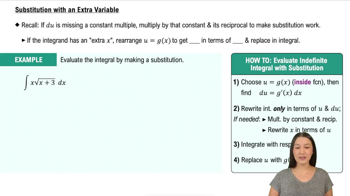
Substitution With an Extra Variable

Properties of Logarithmic Functions

Understanding the properties of logarithms, including the natural logarithm (ln), is essential for manipulating and simplifying expressions involving logs. Key properties include the chain rule for derivatives and the behavior of ln(x) and ln(ln x), which help in recognizing substitution candidates and handling absolute values in integrals.
Video consigliato:
Percorso guidato
06:21
Properties of Functions

Definite Integrals and Absolute Values

When evaluating definite integrals involving logarithmic functions, it is important to consider the domain and sign of the expressions inside logarithms. Absolute values are included in antiderivatives of ln(x) to ensure the function is defined for all valid x. Determining when absolute values are necessary depends on the interval of integration and the function's behavior.
Video consigliato:
Percorso guidato
05:43
Definition of the Definite Integral