Ch. 7 - Logarithmic, Exponential Functions, and Hyperbolic Functions
Briggs - Calculus: Early Transcendentals 3rd Edition
Briggs3rd EditionCalculus: Early TranscendentalsISBN: 9780136847243Non è quello che usi tu?Cambia libro di testo
Capitolo 7, Problema 7.3.63

63–68. Definite integrals Evaluate the following definite integrals. Use Theorem 7.7 to express your answer in terms of logarithms.
∫₁ᵉ^² dx/x√(ln²x + 1)

Guida verificata passo dopo passo
1
Identify the integral to be evaluated: \(\displaystyle \int_1^{e^2} \frac{1}{x \sqrt{(\ln x)^2 + 1}} \, dx\).
Recognize that the integrand involves \(\ln x\) and its derivative. Consider the substitution \(t = \ln x\), which implies \(dt = \frac{1}{x} dx\).
Rewrite the integral in terms of \(t\): since \(x\) goes from 1 to \(e^2\), then \(t\) goes from \(\ln 1 = 0\) to \(\ln e^2 = 2\). The integral becomes \(\int_0^2 \frac{1}{\sqrt{t^2 + 1}} \, dt\).
Recall that \(\int \frac{1}{\sqrt{t^2 + 1}} \, dt\) is a standard integral whose antiderivative is \(\sinh^{-1}(t)\) or equivalently \(\ln(t + \sqrt{t^2 + 1})\) (this is Theorem 7.7, expressing inverse hyperbolic sine in terms of logarithms).
Evaluate the definite integral by substituting the limits \(t=0\) and \(t=2\) into the antiderivative \(\ln(t + \sqrt{t^2 + 1})\) and subtracting: \(\left. \ln(t + \sqrt{t^2 + 1}) \right|_0^2\).

Risposta video verificata per un problema simile:

Questa soluzione video è stata consigliata dai nostri tutor come utile per risolvere questo problema.
Durata del video:
3m

Concetti chiave

Ecco i concetti essenziali che devi comprendere per rispondere correttamente alla domanda.

Definite Integrals

A definite integral calculates the net area under a curve between two specific limits. It is represented as ∫_a^b f(x) dx, where a and b are the lower and upper bounds. Evaluating definite integrals often involves finding an antiderivative and then applying the Fundamental Theorem of Calculus.
Video consigliato:
Percorso guidato
05:43
Definition of the Definite Integral

Substitution Method

The substitution method simplifies integrals by changing variables to transform the integral into a more manageable form. Typically, a substitution u = g(x) is chosen so that du replaces part of the integrand, making integration straightforward. This method is especially useful when the integrand contains composite functions.
Video consigliato:
07:33
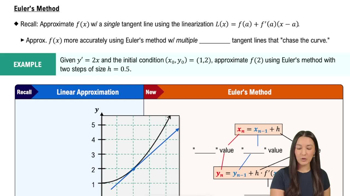
Euler's Method

Logarithmic Functions and Their Properties

Logarithmic functions, such as ln(x), are inverses of exponential functions and have properties that simplify expressions involving products, quotients, and powers. In integration, expressing answers in terms of logarithms often involves recognizing derivatives of ln(x) and using log rules to rewrite results clearly.
Video consigliato:
Percorso guidato
06:21
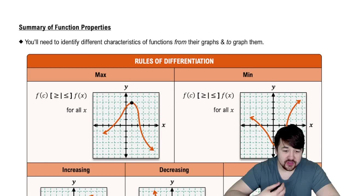
Properties of Functions