


Compounded inflation The U.S. government reports the rate of inflation (as measured by the consumer index) both monthly and annually. Suppose for a particular month, the monthly rate of inflation is reported as 0.8%. Assuming this rate remains constant, what is the corresponding annual rate of inflation? Is the annual rate 12 times the monthly rate? Explain.
Ch. 7 - Logarithmic, Exponential Functions, and Hyperbolic Functions
Briggs3rd EditionCalculus: Early TranscendentalsISBN: 9780136847243Non è quello che usi tu?Cambia libro di testo
Tutti i libri di testo
Briggs 3rd Edition
Ch. 7 - Logarithmic, Exponential Functions, and Hyperbolic Functions
Problema 7.3.45
Briggs 3rd Edition
Ch. 7 - Logarithmic, Exponential Functions, and Hyperbolic Functions
Problema 7.3.45Capitolo 7, Problema 7.3.45
37–56. Integrals Evaluate each integral.
∫₀ ˡⁿ ² tanh x dx
Guida verificata passo dopo passo1
Recognize that the integral to evaluate is \(\int_0^{\ln 2} \tanh x \, dx\), where \(\tanh x = \frac{\sinh x}{\cosh x}\).
Recall the definition of hyperbolic tangent: \(\tanh x = \frac{e^x - e^{-x}}{e^x + e^{-x}}\), but it is often easier to work with the derivative of \(\ln(\cosh x)\) since \(\frac{d}{dx} \ln(\cosh x) = \tanh x\).
Use the fact that \(\frac{d}{dx} \ln(\cosh x) = \tanh x\) to rewrite the integral as \(\int_0^{\ln 2} \tanh x \, dx = \left[ \ln(\cosh x) \right]_0^{\ln 2}\).
Evaluate the expression \(\ln(\cosh x)\) at the upper limit \(x = \ln 2\) and the lower limit \(x = 0\) separately.
Subtract the value at the lower limit from the value at the upper limit to find the value of the definite integral: \(\ln(\cosh(\ln 2)) - \ln(\cosh(0))\).

Risposta video verificata per un problema simile:
Questa soluzione video è stata consigliata dai nostri tutor come utile per risolvere questo problema.
Durata del video:
3mConcetti chiave
Ecco i concetti essenziali che devi comprendere per rispondere correttamente alla domanda.
Definite Integrals
A definite integral calculates the net area under a curve between two specific limits. It is represented as ∫_a^b f(x) dx, where a and b are the lower and upper bounds. Evaluating definite integrals often involves finding an antiderivative and then applying the Fundamental Theorem of Calculus.
Video consigliato:
Percorso guidato
Definition of the Definite Integral
Hyperbolic Functions and Their Properties
Hyperbolic functions like tanh(x) are analogs of trigonometric functions but based on exponential functions. The function tanh(x) = (e^x - e^{-x}) / (e^x + e^{-x}) is continuous and differentiable, with known derivatives and integrals that simplify integration tasks.
Video consigliato:
Percorso guidato
Properties of Functions
Integration Techniques for Hyperbolic Functions
Integrating hyperbolic functions often involves recognizing standard integral forms or using substitution. For tanh(x), the integral can be expressed in terms of logarithmic functions, since d/dx [ln(cosh x)] = tanh x, which helps in evaluating definite integrals efficiently.
Video consigliato:
Percorso guidato
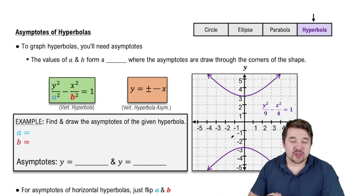
Asymptotes of Hyperbolas
Pratica correlata
Domanda del libro di testo
100
views
Domanda del libro di testo
29–62. Integrals Evaluate the following integrals. Include absolute values only when needed.
∫₀^{π/2} 4^{sin x} cos x dx
50
views
Domanda del libro di testo
22–36. Derivatives Find the derivatives of the following functions.
f(x) = √coth 3x
76
views
Domanda del libro di testo
Points of inflection Find the x-coordinate of the point(s) of inflection of f(x) = tanh² x.
86
views
Domanda del libro di testo
7–28. Derivatives Evaluate the following derivatives.
d/dt ((sin t)^{√t})
46
views
Domanda del libro di testo
57–58. Two ways
Evaluate the following integrals two ways.
a. Simplify the integrand first and then integrate.
b. Change variables (let u = ln x), integrate, and then simplify your answer. Verify that both methods give the same answer.
∫ (sinh (ln x)) / x dx
39
views