Ch. 7 - Logarithmic, Exponential Functions, and Hyperbolic Functions
Briggs - Calculus: Early Transcendentals 3rd Edition
Briggs3rd EditionCalculus: Early TranscendentalsISBN: 9780136847243Non è quello che usi tu?Cambia libro di testo
Capitolo 7, Problema 7.2.49

Compounded inflation The U.S. government reports the rate of inflation (as measured by the consumer index) both monthly and annually. Suppose for a particular month, the monthly rate of inflation is reported as 0.8%. Assuming this rate remains constant, what is the corresponding annual rate of inflation? Is the annual rate 12 times the monthly rate? Explain.

Guida verificata passo dopo passo
1
Understand that the monthly inflation rate is given as 0.8%, which can be expressed as a decimal: \(0.008\).
Recognize that inflation compounds monthly, so the annual inflation rate is not simply 12 times the monthly rate, but rather calculated using compound interest principles.
Use the formula for compound growth over 12 months: \(\text{Annual Rate} = (1 + \text{Monthly Rate})^{12} - 1\).
Substitute the monthly rate into the formula: \(\text{Annual Rate} = (1 + 0.008)^{12} - 1\).
Interpret the result as the total percentage increase over the year, which accounts for compounding, and compare it to the simple multiplication \(12 \times 0.8\%\) to see the difference.

Risposta video verificata per un problema simile:

Questa soluzione video è stata consigliata dai nostri tutor come utile per risolvere questo problema.
Durata del video:
2m

Concetti chiave

Ecco i concetti essenziali che devi comprendere per rispondere correttamente alla domanda.

Compound Interest and Growth

Compound growth occurs when increases are applied to the accumulated amount over multiple periods, not just the original value. In inflation, monthly rates compound over 12 months, so the annual rate is found by multiplying the monthly growth factors, not simply by multiplying the rate by 12.
Video consigliato:
09:29
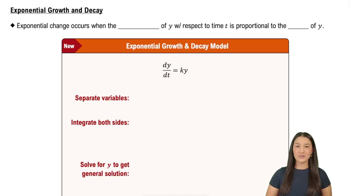
Exponential Growth & Decay

Converting Monthly Inflation Rate to Annual Rate

To find the annual inflation rate from a monthly rate, raise (1 + monthly rate) to the 12th power and subtract 1. This accounts for compounding effects, showing that the annual rate is generally higher than 12 times the monthly rate.
Video consigliato:
Percorso guidato
04:16
Intro To Related Rates

Difference Between Simple and Compound Rates

Simple interest or growth adds the same amount each period, while compound interest grows exponentially by applying the rate to the new total each time. Inflation rates compound, so annual inflation is not a simple multiple of monthly inflation.
Video consigliato:
Percorso guidato
04:16
Intro To Related Rates