

Ch. 7 - Logarithmic, Exponential Functions, and Hyperbolic Functions
Briggs - Calculus: Early Transcendentals 3rd Edition
Briggs3rd EditionCalculus: Early TranscendentalsISBN: 9780136847243Non è quello che usi tu?Cambia libro di testo
Capitolo 7, Problema 7.3.65

63–68. Definite integrals Evaluate the following definite integrals. Use Theorem 7.7 to express your answer in terms of logarithms.
∫₋₂² dt/(t² – 9)

Guida verificata passo dopo passo
1
Identify the integral to evaluate: \(\displaystyle \int_{-2}^{2} \frac{dt}{t^{2} - 9}\).
Recognize that the denominator can be factored using the difference of squares: \(t^{2} - 9 = (t - 3)(t + 3)\).
Set up the partial fraction decomposition: \(\frac{1}{t^{2} - 9} = \frac{A}{t - 3} + \frac{B}{t + 3}\), and solve for constants \(A\) and \(B\).
Rewrite the integral as the sum of two integrals involving \(\frac{1}{t - 3}\) and \(\frac{1}{t + 3}\), then integrate each term separately to get expressions involving logarithms.
Apply the Fundamental Theorem of Calculus (Theorem 7.7) by evaluating the antiderivative at the upper limit \(2\) and the lower limit \(-2\), then subtract to find the definite integral.

Risposta video verificata per un problema simile:

Questa soluzione video è stata consigliata dai nostri tutor come utile per risolvere questo problema.
Durata del video:
5m

Concetti chiave

Ecco i concetti essenziali che devi comprendere per rispondere correttamente alla domanda.

Definite Integrals

A definite integral calculates the net area under a curve between two limits. It is represented as ∫_a^b f(t) dt, where a and b are the bounds. Evaluating definite integrals often involves finding an antiderivative and then applying the Fundamental Theorem of Calculus.
Video consigliato:
Percorso guidato
05:43
Definition of the Definite Integral

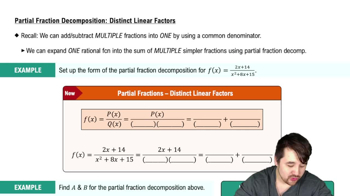
Partial Fraction Decomposition

Partial fraction decomposition breaks a rational function into simpler fractions that are easier to integrate. For integrals involving rational functions like 1/(t² - 9), this method helps rewrite the integrand into terms whose antiderivatives are known, such as logarithmic functions.
Video consigliato:
Percorso guidato
10:07
Partial Fraction Decomposition: Distinct Linear Factors

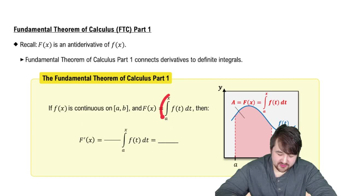
Logarithmic Integration and Theorem 7.7

Theorem 7.7 typically refers to the integral of 1/(x - a) being ln|x - a| + C. When integrating rational functions that factor into linear terms, the antiderivative often involves logarithms. Expressing the answer in terms of logarithms means using this theorem to write the integral in a simplified logarithmic form.
Video consigliato:
Percorso guidato
06:11
Fundamental Theorem of Calculus Part 1