
Ch. 7 - Logarithmic, Exponential Functions, and Hyperbolic Functions
Briggs - Calculus: Early Transcendentals 3rd Edition
Briggs3rd EditionCalculus: Early TranscendentalsISBN: 9780136847243Non è quello che usi tu?Cambia libro di testo
Capitolo 7, Problema 7.2.7

Suppose a quantity described by the function y(t) = y₀eᵏᵗ, where t is measured in years, has a doubling time of 20 years. Find the rate constant k.

Guida verificata passo dopo passo
1
Identify the given function: \(y(t) = y_0 e^{k t}\), where \(y_0\) is the initial quantity, \(k\) is the rate constant, and \(t\) is time in years.
Understand the meaning of doubling time: the time it takes for the quantity to double, so when \(t = 20\), \(y(20) = 2 y_0\).
Set up the equation using the doubling condition: \(2 y_0 = y_0 e^{k \times 20}\).
Divide both sides by \(y_0\) to simplify: \(2 = e^{20 k}\).
Take the natural logarithm of both sides to solve for \(k\): \(\ln(2) = 20 k\), then isolate \(k\) as \(k = \frac{\ln(2)}{20}\).

Risposta video verificata per un problema simile:

Questa soluzione video è stata consigliata dai nostri tutor come utile per risolvere questo problema.
Durata del video:
3m

Concetti chiave

Ecco i concetti essenziali che devi comprendere per rispondere correttamente alla domanda.

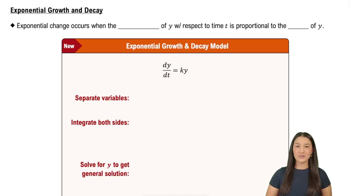
Exponential Growth Function

An exponential growth function models quantities that increase at a rate proportional to their current value, expressed as y(t) = y₀e^{kt}. Here, y₀ is the initial amount, k is the growth rate constant, and t is time. Understanding this form is essential to relate growth behavior to the rate constant.
Video consigliato:
09:29
Exponential Growth & Decay

Doubling Time

Doubling time is the period required for a quantity undergoing exponential growth to double in size. It is related to the rate constant k by the formula T = ln(2)/k, where T is the doubling time. This relationship allows solving for k when the doubling time is known.
Video consigliato:
02:32
Verifying Solutions of Differential Equations Example 3

Natural Logarithm and Solving for k

The natural logarithm (ln) is the inverse of the exponential function and is used to solve equations involving exponentials. To find k, take the natural logarithm of both sides of the doubling time equation, enabling isolation and calculation of k from known values.
Video consigliato:
5:02
Solving Logarithmic Equations