Ch. 7 - Logarithmic, Exponential Functions, and Hyperbolic Functions
Briggs - Calculus: Early Transcendentals 3rd Edition
Briggs3rd EditionCalculus: Early TranscendentalsISBN: 9780136847243Non è quello che usi tu?Cambia libro di testo
Capitolo 7, Problema 7.2.50c

Acceleration, velocity, position Suppose the acceleration of an object moving along a line is given by a(t) = -k v(t), where k is a positive constant and v is the object's velocity. Assume the initial velocity and position are given by v(0) = 10 and s(0) = 0, respectively.
c. Use the fact that dv/dt = (dv/ds)(ds/dt) (by the Chain Rule) to find the velocity as a function of position.

Guida verificata passo dopo passo
1
Start with the given acceleration equation: \(a(t) = -k v(t)\), where \(a(t) = \frac{dv}{dt}\) and \(v(t)\) is the velocity.
Use the Chain Rule relationship: \(\frac{dv}{dt} = \frac{dv}{ds} \cdot \frac{ds}{dt}\). Since \(\frac{ds}{dt} = v\), rewrite acceleration as \(a = \frac{dv}{dt} = v \frac{dv}{ds}\).
Substitute \(a = -k v\) into the Chain Rule expression to get: \(v \frac{dv}{ds} = -k v\).
Divide both sides by \(v\) (assuming \(v \neq 0\)) to simplify: \(\frac{dv}{ds} = -k\).
Integrate both sides with respect to \(s\) to find \(v\) as a function of \(s\): \(\int dv = \int -k \, ds\), which leads to \(v(s) = -k s + C\). Use the initial conditions to solve for the constant \(C\).

Risposta video verificata per un problema simile:

Questa soluzione video è stata consigliata dai nostri tutor come utile per risolvere questo problema.
Durata del video:
4m

Concetti chiave

Ecco i concetti essenziali che devi comprendere per rispondere correttamente alla domanda.

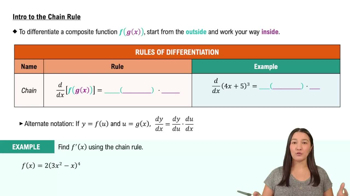
Chain Rule in Calculus

The Chain Rule allows differentiation of composite functions by relating rates of change. In this problem, it connects acceleration a(t) = dv/dt to velocity and position via dv/dt = (dv/ds)(ds/dt), enabling us to express velocity as a function of position instead of time.
Video consigliato:
05:02
Intro to the Chain Rule

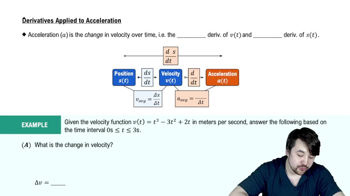
Relationship Between Velocity, Position, and Acceleration

Velocity is the rate of change of position with respect to time (v = ds/dt), and acceleration is the rate of change of velocity with respect to time (a = dv/dt). Understanding these relationships is essential to rewrite acceleration in terms of velocity and position, facilitating the solution.
Video consigliato:
Percorso guidato
06:15
Derivatives Applied To Acceleration

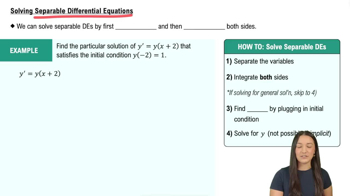
Solving First-Order Differential Equations

The problem leads to a separable differential equation involving velocity and position. Solving such equations requires isolating variables and integrating both sides, which yields velocity as a function of position, given initial conditions.
Video consigliato:
06:06
Solving Separable Differential Equations
Pratica correlata
Domanda del libro di testo

Properties of exp(x) Use the inverse relations between ln x and exp(x), and the properties of ln x, to prove the following properties:


c. (exp(x))ᵖ = exp(px), p rational

62
views

Domanda del libro di testo

Energy consumption On the first day of the year (t=0), a city uses electricity at a rate of 2000 MW. That rate is projected to increase at a rate of 1.3% per year.


b. Find the total energy (in MW-yr) used by the city over four full years beginning at t=0.

41
views
Domanda del libro di testo

Explain why or why not Determine whether the following statements are true and give an explanation or counterexample.

c. ln(1 + √2) = −ln(−1 + √2)

53
views
Domanda del libro di testo

Evaluating hyperbolic functions Use a calculator to evaluate each expression or state that the value does not exist. Report answers accurate to four decimal places to the right of the decimal point.

c. csch⁻¹ 5

59
views
Domanda del libro di testo

Definitions of hyperbolic sine and cosine Complete the following steps to prove that when the x- and y-coordinates of a point on the hyperbola x² - y² = 1 are defined as cosh t and sinh t, respectively, where t is twice the area of the shaded region in the figure, x and y can be expressed as

x = cosh t = (eᵗ + e⁻ᵗ) / 2 and y = sinh t = (eᵗ - e⁻ᵗ) / 2.


b. In Chapter 8, the formula for the integral in part (a) is derived:

∫ √(z² − 1) dz = (z/2)√(z² − 1) − (1/2) ln|z + √(z² − 1)| + C.

Evaluate this integral on the interval [1, x], explain why the absolute value can be dropped, and combine the result with part (a) to show that:

t = ln(x + √(x² − 1)).

96
views
Domanda del libro di testo

Power lines A power line is attached at the same height to two utility poles that are separated by a distance of 100 ft; the power line follows the curve ƒ(x) = a cosh x/a. Use the following steps to find the value of a that produces a sag of 10 ft midway between the poles. Use a coordinate system that places the poles at x = ±50.

c. Use your answer in part (b) to find a, and then compute the length of the power line.

32
views