
Ch. 7 - Logarithmic, Exponential Functions, and Hyperbolic Functions
Briggs - Calculus: Early Transcendentals 3rd Edition
Briggs3rd EditionCalculus: Early TranscendentalsISBN: 9780136847243Non è quello che usi tu?Cambia libro di testo
Capitolo 7, Problema 7.3.78c

Evaluating hyperbolic functions Use a calculator to evaluate each expression or state that the value does not exist. Report answers accurate to four decimal places to the right of the decimal point.
c. csch⁻¹ 5

Guida verificata passo dopo passo
1
Recognize that the expression csch⁻¹(5) represents the inverse hyperbolic cosecant function evaluated at 5, which means we want to find the value of x such that csch(x) = 5.
Recall the definition of the hyperbolic cosecant function: \(\text{csch}(x) = \frac{1}{\sinh(x)}\), so the equation \(\text{csch}(x) = 5\) can be rewritten as \(\frac{1}{\sinh(x)} = 5\).
Solve for \(\sinh(x)\) by taking the reciprocal: \(\sinh(x) = \frac{1}{5}\).
Use the inverse hyperbolic sine function to find \(x\): \(x = \sinh^{-1}\left(\frac{1}{5}\right)\).
Use a calculator to evaluate \(\sinh^{-1}\left(\frac{1}{5}\right)\) and report the answer accurate to four decimal places.

Risposta video verificata per un problema simile:

Questa soluzione video è stata consigliata dai nostri tutor come utile per risolvere questo problema.
Durata del video:
2m

Concetti chiave

Ecco i concetti essenziali che devi comprendere per rispondere correttamente alla domanda.

Inverse Hyperbolic Functions

Inverse hyperbolic functions, such as csch⁻¹(x), are the inverses of hyperbolic functions and return the value whose hyperbolic function equals x. They are used to solve equations involving hyperbolic functions and often require understanding their domain and range.
Video consigliato:
4:49
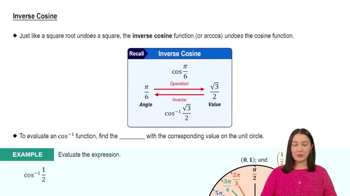
Inverse Cosine

Domain and Range of csch⁻¹(x)

The inverse hyperbolic cosecant function, csch⁻¹(x), is defined for all real x except zero, since csch(x) = 1/sinh(x) is undefined at zero. Understanding its domain helps determine if the expression has a valid value or does not exist.
Video consigliato:
Percorso guidato
5:10
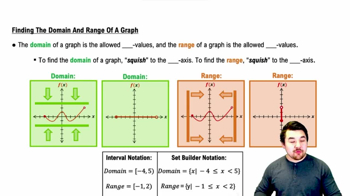
Finding the Domain and Range of a Graph

Calculator Evaluation and Decimal Precision

Using a calculator to evaluate inverse hyperbolic functions requires inputting the correct function and ensuring the result is rounded to the specified decimal places. Accurate rounding to four decimal places ensures precision in reporting the answer.
Video consigliato:
5:14
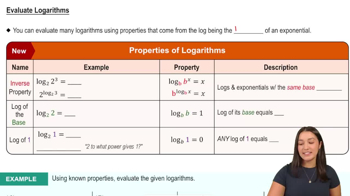
Evaluate Logarithms
Pratica correlata
Domanda del libro di testo

Acceleration, velocity, position Suppose the acceleration of an object moving along a line is given by a(t) = -k v(t), where k is a positive constant and v is the object's velocity. Assume the initial velocity and position are given by v(0) = 10 and s(0) = 0, respectively.

c. Use the fact that dv/dt = (dv/ds)(ds/dt) (by the Chain Rule) to find the velocity as a function of position.

108
views
Domanda del libro di testo

Properties of exp(x) Use the inverse relations between ln x and exp(x), and the properties of ln x, to prove the following properties:


c. (exp(x))ᵖ = exp(px), p rational

62
views
Domanda del libro di testo

Explain why or why not Determine whether the following statements are true and give an explanation or counterexample.

c. ln(1 + √2) = −ln(−1 + √2)

53
views
Domanda del libro di testo

Velocity of falling body Refer to Exercise 95, which gives the position function for a falling body. Use m = 75 kg and k = 0.2.


c. How long does it take for the BASE jumper to reach a speed of 45 m/s (roughly 100 mi/hr)?

39
views
Domanda del libro di testo

ln x is unbounded Use the following argument to show that lim (x → ∞) ln x = ∞ and lim (x → 0⁺) ln x = −∞.

c. Show that ln 2ⁿ > n/2 and ln 2^(−n) < −n/2.

100
views
Domanda del libro di testo

Power lines A power line is attached at the same height to two utility poles that are separated by a distance of 100 ft; the power line follows the curve ƒ(x) = a cosh x/a. Use the following steps to find the value of a that produces a sag of 10 ft midway between the poles. Use a coordinate system that places the poles at x = ±50.

c. Use your answer in part (b) to find a, and then compute the length of the power line.

32
views