
Ch. 7 - Logarithmic, Exponential Functions, and Hyperbolic Functions
Briggs - Calculus: Early Transcendentals 3rd Edition
Briggs3rd EditionCalculus: Early TranscendentalsISBN: 9780136847243Non è quello che usi tu?Cambia libro di testo
Capitolo 7, Problema 7.RE.1a

Explain why or why not Determine whether the following statements are true and give an explanation or counterexample.


a. The variable y = t + 1 doubles in value whenever t increases by 1 unit.

Guida verificata passo dopo passo
1
Identify the given function: \(y = t + 1\).
Understand what it means for \(y\) to double when \(t\) increases by 1 unit. Doubling means the new value of \(y\) should be twice the original value.
Calculate the original value of \(y\) at some \(t\): \(y = t + 1\).
Calculate the new value of \(y\) when \(t\) increases by 1: \(y_{new} = (t + 1) + 1 = t + 2\).
Compare \(y_{new}\) to \$2y$: check if $t + 2 = 2(t + 1)$ holds for all $t$. If not, then $y$ does not double when $t$ increases by 1.

Risposta video verificata per un problema simile:

Questa soluzione video è stata consigliata dai nostri tutor come utile per risolvere questo problema.
Durata del video:
3m

Concetti chiave

Ecco i concetti essenziali che devi comprendere per rispondere correttamente alla domanda.

Understanding Linear Functions

A linear function has the form y = mt + b, where m is the slope and b is the y-intercept. The slope m represents the rate of change of y with respect to t, meaning how much y changes when t increases by one unit.
Video consigliato:

Rate of Change vs. Doubling

Rate of change refers to the amount y increases or decreases per unit increase in t. Doubling means y becomes twice its previous value, which is a multiplicative change, not additive. Understanding this distinction is key to evaluating the statement.
Video consigliato:
Percorso guidato
04:16
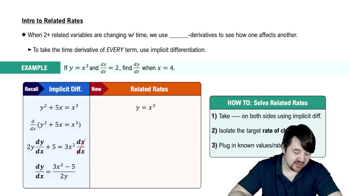
Intro To Related Rates

Counterexamples in Mathematical Reasoning

A counterexample disproves a general statement by providing a specific case where the statement fails. To test if y doubles when t increases by 1, substituting values can show whether the statement holds or not.
Video consigliato:
Percorso guidato
11:50
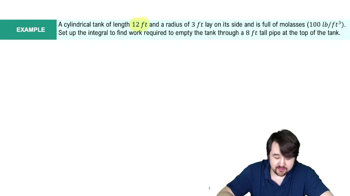
Pumping Liquids Example 5