Ch. 7 - Logarithmic, Exponential Functions, and Hyperbolic Functions
Briggs - Calculus: Early Transcendentals 3rd Edition
Briggs3rd EditionCalculus: Early TranscendentalsISBN: 9780136847243Non è quello che usi tu?Cambia libro di testo
Capitolo 7, Problema 7.1.74c

ln x is unbounded Use the following argument to show that lim (x → ∞) ln x = ∞ and lim (x → 0⁺) ln x = −∞.
c. Show that ln 2ⁿ > n/2 and ln 2^(−n) < −n/2.

Guida verificata passo dopo passo
1
Recall the properties of logarithms, specifically that \( \ln(a^b) = b \ln a \). Use this to rewrite \( \ln 2^n \) as \( n \ln 2 \) and \( \ln 2^{-n} \) as \( -n \ln 2 \).
Note that \( \ln 2 \) is a positive constant since 2 is greater than 1. To show \( \ln 2^n > \frac{n}{2} \), compare \( n \ln 2 \) with \( \frac{n}{2} \). This reduces to showing \( \ln 2 > \frac{1}{2} \).
Similarly, to show \( \ln 2^{-n} < -\frac{n}{2} \), compare \( -n \ln 2 \) with \( -\frac{n}{2} \). This reduces to showing \( \ln 2 > \frac{1}{2} \) again, which is consistent with the previous step.
Since \( \ln 2 \) is approximately 0.693, which is greater than 0.5, both inequalities hold true for all positive integers \( n \).
These inequalities help illustrate the behavior of \( \ln x \) as \( x \to \infty \) and \( x \to 0^+ \) by bounding the logarithm with linear functions that tend to infinity or negative infinity, respectively.

Risposta video verificata per un problema simile:

Questa soluzione video è stata consigliata dai nostri tutor come utile per risolvere questo problema.
Durata del video:
1m

Concetti chiave

Ecco i concetti essenziali che devi comprendere per rispondere correttamente alla domanda.

Behavior of the Natural Logarithm Function

The natural logarithm function, ln(x), increases without bound as x approaches infinity, and decreases without bound as x approaches zero from the right. This means lim (x → ∞) ln(x) = ∞ and lim (x → 0⁺) ln(x) = −∞, reflecting its unbounded growth and decay.
Video consigliato:
05:18
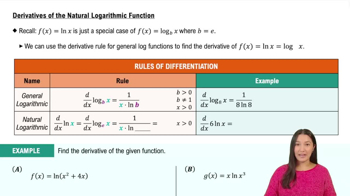
Derivative of the Natural Logarithmic Function

Properties of Exponents and Logarithms

Logarithms and exponents are inverse operations. For any positive base a, ln(a^n) = n ln(a). This property allows us to rewrite expressions like ln(2^n) as n ln(2), facilitating comparisons and inequalities involving exponential and logarithmic terms.
Video consigliato:
05:36
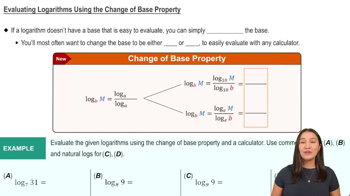
Change of Base Property

Inequalities Involving Logarithms

To show inequalities such as ln(2^n) > n/2, one uses known bounds or approximations of ln(2). Since ln(2) ≈ 0.693 > 0.5, multiplying by n preserves the inequality. Similarly, for negative exponents, ln(2^{-n}) = -n ln(2) < -n/2, demonstrating how logarithmic inequalities relate to linear bounds.
Video consigliato:
07:01
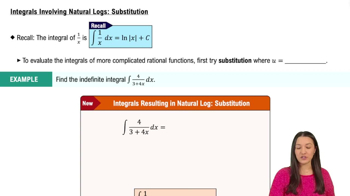
Integrals Involving Natural Logs: Substitution
Pratica correlata
Domanda del libro di testo

Properties of exp(x) Use the inverse relations between ln x and exp(x), and the properties of ln x, to prove the following properties:


c. (exp(x))ᵖ = exp(px), p rational

62
views

Domanda del libro di testo

Oil consumption Starting in 2018 (t=0), the rate at which oil is consumed by a small country increases at a rate of 1.5%/yr, starting with an initial rate of 1.2 million barrels/yr.


c. How many years after 2018 will the amount of oil consumed since 2018 reach 10 million barrels?

43
views
Domanda del libro di testo

Evaluating hyperbolic functions Use a calculator to evaluate each expression or state that the value does not exist. Report answers accurate to four decimal places to the right of the decimal point.

c. csch⁻¹ 5

59
views
Domanda del libro di testo

Energy consumption On the first day of the year (t=0), a city uses electricity at a rate of 2000 MW. That rate is projected to increase at a rate of 1.3% per year.


c. Find a function that gives the total energy used (in MW-yr) between t=0 and any future time t>0.

35
views
Domanda del libro di testo

Velocity of falling body Refer to Exercise 95, which gives the position function for a falling body. Use m = 75 kg and k = 0.2.


c. How long does it take for the BASE jumper to reach a speed of 45 m/s (roughly 100 mi/hr)?

39
views
Domanda del libro di testo

Explain why or why not Determine whether the following statements are true and give an explanation or counterexample. Assume x > 0 and y > 0.


c. ln (x + y) = ln x + ln y

79
views