Rule of 70 Bankers use the Rule of 70, which says that if an account increases at a fixed rate of p%/yr, its doubling time is approximately 70/p. Use linear approximation to explain why and when this is true.
Ch. 7 - Logarithmic, Exponential Functions, and Hyperbolic Functions
Briggs3rd EditionCalculus: Early TranscendentalsISBN: 9780136847243Non è quello che usi tu?Cambia libro di testo
Tutti i libri di testo
Briggs 3rd Edition
Ch. 7 - Logarithmic, Exponential Functions, and Hyperbolic Functions
Problema 7.3.94
Briggs 3rd Edition
Ch. 7 - Logarithmic, Exponential Functions, and Hyperbolic Functions
Problema 7.3.94Capitolo 7, Problema 7.3.94
Newton’s method Use Newton’s method to find all local extreme values of ƒ(x) = x sech x.
Guida verificata passo dopo passo1
Start by recalling that local extreme values occur where the first derivative of the function is zero and the second derivative test can be applied to classify the critical points.
Given the function \(f(x) = x \, \text{sech} \; x\), first find the derivative \(f'(x)\) using the product rule: \(f'(x) = \frac{d}{dx}[x] \cdot \text{sech} \; x + x \cdot \frac{d}{dx}[\text{sech} \; x]\).
Calculate the derivative of \(\text{sech} \; x\), which is \(\frac{d}{dx}[\text{sech} \; x] = -\text{sech} \; x \tanh x\), and substitute it back into the expression for \(f'(x)\) to get \(f'(x) = \text{sech} \; x - x \, \text{sech} \; x \tanh x\).
Set \(f'(x) = 0\) to find critical points: \(\text{sech} \; x - x \text{sech} \; x \tanh x = 0\). Simplify this to \(1 - x \tanh x = 0\), or equivalently \(x \tanh x = 1\).
Use Newton's method to solve \(g(x) = x \tanh x - 1 = 0\). Compute \(g'(x) = \tanh x + x \, \text{sech}^2 x\), then iterate using the formula \(x_{n+1} = x_n - \frac{g(x_n)}{g'(x_n)}\) starting from an initial guess to approximate the roots where \(f'(x) = 0\).

Risposta video verificata per un problema simile:
Questa soluzione video è stata consigliata dai nostri tutor come utile per risolvere questo problema.
Durata del video:
4mConcetti chiave
Ecco i concetti essenziali che devi comprendere per rispondere correttamente alla domanda.
Newton’s Method
Newton’s method is an iterative numerical technique used to approximate roots of a real-valued function. Starting from an initial guess, it uses the function and its derivative to generate successively better approximations. The formula is x_{n+1} = x_n - f(x_n)/f'(x_n). It is especially useful when analytical solutions are difficult.
Video consigliato:
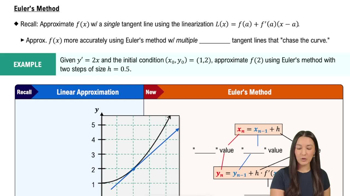
Euler's Method
Local Extreme Values
Local extreme values of a function are points where the function attains a local maximum or minimum. These occur where the first derivative is zero or undefined, and the second derivative test or other methods determine the nature of these points. Finding these values helps understand the function’s behavior.
Video consigliato:
Finding Global Extrema (Extreme Value Theorem)
Derivative of the Function f(x) = x sech x
To find local extrema, you need the first derivative of f(x) = x sech x. This requires applying the product rule and the derivative of sech x, which is -sech x tanh x. Correctly computing f'(x) is essential for setting up the equation f'(x) = 0 to find critical points.
Video consigliato:
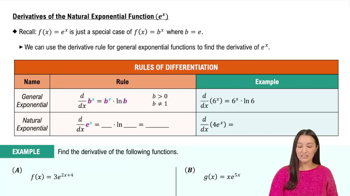
Derivative of the Natural Exponential Function (e^x)
Pratica correlata
Domanda del libro di testo
71
views
Domanda del libro di testo
37–56. Integrals Evaluate each integral.
∫ cosh 2x dx
97
views
Domanda del libro di testo
11–15. Identities Prove each identity using the definitions of the hyperbolic functions.
tanh(−x) = −tanh x
91
views
Domanda del libro di testo
22–36. Derivatives Find the derivatives of the following functions.
f(t) = 2 tanh⁻¹ √t
72
views
Domanda del libro di testo
Uranium dating Uranium-238 (U-238) has a half-life of 4.5 billion years. Geologists find a rock containing a mixture of U-238 and lead, and they determine that 85% of the original U-238 remains; the other 15% has decayed into lead. How old is the rock?
142
views
Domanda del libro di testo
Arc length Use the result of Exercise 108 to find the arc length of the curve: f(x) = ln |tanh(x / 2)| on [ln 2, ln 8].
44
views