
Ch. 7 - Logarithmic, Exponential Functions, and Hyperbolic Functions
Briggs - Calculus: Early Transcendentals 3rd Edition
Briggs3rd EditionCalculus: Early TranscendentalsISBN: 9780136847243Non è quello che usi tu?Cambia libro di testo
Capitolo 7, Problema 7.2.48

Rule of 70 Bankers use the Rule of 70, which says that if an account increases at a fixed rate of p%/yr, its doubling time is approximately 70/p. Use linear approximation to explain why and when this is true.

Guida verificata passo dopo passo
1
Start by expressing the doubling time problem in terms of exponential growth: if an amount grows at a rate of \(p\%\) per year, the amount after time \(t\) years is given by \(A(t) = A_0 e^{rt}\), where \(r = \frac{p}{100}\) is the growth rate as a decimal.
The doubling time \(T\) satisfies \(A(T) = 2A_0\), so we set up the equation \(2A_0 = A_0 e^{rT}\), which simplifies to \(2 = e^{rT}\).
Take the natural logarithm of both sides to solve for \(T\): \(\ln(2) = rT\), so \(T = \frac{\ln(2)}{r}\).
Use linear approximation by noting that \(\ln(2) \approx 0.693\), which is close to \(0.7\), and rewrite \(T\) as \(T \approx \frac{0.7}{r} = \frac{0.7}{p/100} = \frac{70}{p}\), which is the Rule of 70.
This approximation is valid when \(p\) is small because the exponential function can be closely approximated by its linearization near zero growth rates, making the Rule of 70 a good estimate for doubling time at modest growth rates.

Risposta video verificata per un problema simile:

Questa soluzione video è stata consigliata dai nostri tutor come utile per risolvere questo problema.
Durata del video:
3m

Concetti chiave

Ecco i concetti essenziali che devi comprendere per rispondere correttamente alla domanda.

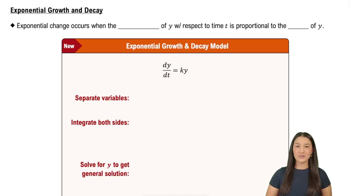
Exponential Growth and Doubling Time

Exponential growth describes how quantities increase at a rate proportional to their current value, leading to doubling over consistent intervals. The doubling time is the period it takes for an amount to double, which depends on the growth rate. Understanding this helps explain why the Rule of 70 approximates doubling time for fixed percentage growth.
Video consigliato:
09:29
Exponential Growth & Decay

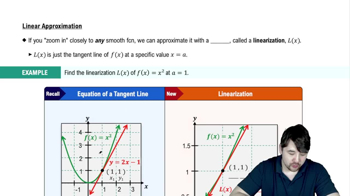
Linear Approximation (Differentials)

Linear approximation uses the tangent line at a point to estimate function values near that point. By approximating nonlinear functions with linear ones, we can simplify complex calculations. In this context, it helps approximate the natural logarithm function to derive the Rule of 70.
Video consigliato:

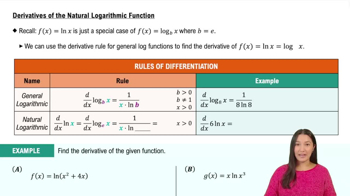
Natural Logarithm and Its Approximation

The natural logarithm function, ln(x), relates to continuous growth and is key in calculating exact doubling times. Near x = 1, ln(1 + r) ≈ r for small r, which allows simplification of the doubling time formula. This approximation underpins why dividing 70 by the percentage rate gives a close estimate.
Video consigliato:
05:18
Derivative of the Natural Logarithmic Function
Pratica correlata
Domanda del libro di testo

Tsunamis A tsunami is an ocean wave often caused by earthquakes on the ocean floor; these waves typically have long wavelengths, ranging from 150 to 1000 km. Imagine a tsunami traveling across the Pacific Ocean, which is the deepest ocean in the world, with an average depth of about 4000 m. Explain why the shallow-water velocity equation (Exercise 75) applies to tsunamis even though the actual depth of the water is large. What does the shallow-water equation say about the speed of a tsunami in the Pacific Ocean (use d = 4000 m)?

67
views
Domanda del libro di testo

Probability as an integral Two points P and Q are chosen randomly, one on each of two adjacent sides of a unit square (see figure). What is the probability that the area of the triangle formed by the sides of the square and the line segment PQ is less than one-fourth the area of the square? Begin by showing that x and y must satisfy xy < 1/2 in order for the area condition to be met. Then argue that the required probability is: 1/2 + ∫[1/2 to 1] (dx / 2x) and evaluate the integral.

58
views
Domanda del libro di testo

37–56. Integrals Evaluate each integral.

∫ cosh 2x dx

97
views
Domanda del libro di testo

11–15. Identities Prove each identity using the definitions of the hyperbolic functions.


tanh(−x) = −tanh x

91
views
Domanda del libro di testo

Newton’s method Use Newton’s method to find all local extreme values of ƒ(x) = x sech x.

65
views
Domanda del libro di testo

Tripling time A quantity increases according to the exponential function y(t) = y₀eᵏᵗ. What is the tripling time for the quantity? What is the time required for the quantity to increase p-fold?

74
views