Ch. 7 - Logarithmic, Exponential Functions, and Hyperbolic Functions
Briggs - Calculus: Early Transcendentals 3rd Edition
Briggs3rd EditionCalculus: Early TranscendentalsISBN: 9780136847243Non è quello che usi tu?Cambia libro di testo
Capitolo 7, Problema 7.2.46b

Overtaking City A has a current population of 500,000 people and grows at a rate of 3%/yr. City B has a current population of 300,000 and grows at a rate of 5%/yr.
b. Suppose City C has a current population of y₀ < 500,000 and a growth rate of p > 3%/yr. What is the relationship between y₀ and p such that Cities A and C have the same population in 10 years?

Guida verificata passo dopo passo
1
Express the population of City A after 10 years using the exponential growth formula: \(P_A(10) = 500,000 \times (1 + 0.03)^{10}\), where 0.03 represents the 3% growth rate.
Express the population of City C after 10 years similarly: \(P_C(10) = y_0 \times (1 + p)^{10}\), where \(y_0\) is the initial population of City C and \(p\) is its growth rate (expressed as a decimal).
Set the populations equal to find when City A and City C have the same population after 10 years: \(500,000 \times (1 + 0.03)^{10} = y_0 \times (1 + p)^{10}\).
Isolate \(y_0\) to express it in terms of \(p\): \(y_0 = \frac{500,000 \times (1 + 0.03)^{10}}{(1 + p)^{10}}\).
Interpret this relationship: for City C to catch up with City A in 10 years, its initial population \(y_0\) and growth rate \(p\) must satisfy the equation above, with \(y_0 < 500,000\) and \(p > 0.03\).

Risposta video verificata per un problema simile:

Questa soluzione video è stata consigliata dai nostri tutor come utile per risolvere questo problema.
Durata del video:
2m

Concetti chiave

Ecco i concetti essenziali che devi comprendere per rispondere correttamente alla domanda.

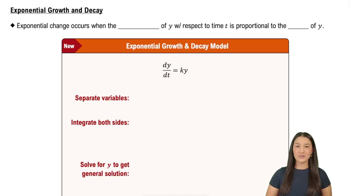
Exponential Growth Model

Population growth at a constant percentage rate is modeled by exponential functions, where the population at time t is given by P(t) = P₀ * (1 + r)^t. Here, P₀ is the initial population, r is the growth rate per time period, and t is the number of time periods. This model helps predict future populations based on current data.
Video consigliato:
09:29
Exponential Growth & Decay

Equating Populations to Find Conditions

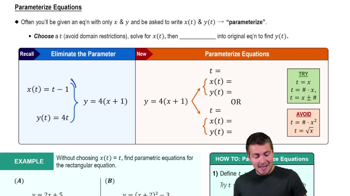
To find when two populations are equal, set their exponential growth expressions equal and solve for the unknown variable. This involves forming an equation like P₀₁*(1 + r₁)^t = P₀₂*(1 + r₂)^t and manipulating it to express one variable in terms of others, which reveals the relationship between initial populations and growth rates.
Video consigliato:
08:02
Parameterizing Equations

Logarithmic Functions for Solving Exponential Equations

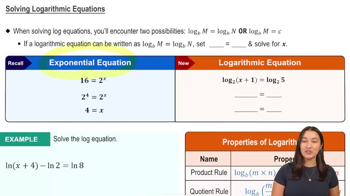
When solving equations involving variables in exponents, logarithms are used to isolate the variable. Taking the natural log or log base 10 of both sides allows the exponent to be brought down as a multiplier, enabling algebraic manipulation to find unknown growth rates or initial populations.
Video consigliato:
5:02
Solving Logarithmic Equations
Pratica correlata
Domanda del libro di testo

Properties of exp(x) Use the inverse relations between ln x and exp(x), and the properties of ln x, to prove the following properties:


b. exp(x − y) = exp(x) / exp(y)

83
views

Domanda del libro di testo

Energy consumption On the first day of the year (t=0), a city uses electricity at a rate of 2000 MW. That rate is projected to increase at a rate of 1.3% per year.


b. Find the total energy (in MW-yr) used by the city over four full years beginning at t=0.

41
views
Domanda del libro di testo

37–38. Caffeine After an individual drinks a beverage containing caffeine, the amount of caffeine in the bloodstream can be modeled by an exponential decay function, with a half-life that depends on several factors, including age and body weight. For the sake of simplicity, assume the caffeine in the following drinks immediately enters the bloodstream upon consumption.


An individual consumes two cups of coffee, each containing 90 mg of caffeine, two hours apart. Assume the half-life of caffeine for this individual is 5.7 hours.


b. Determine the amount of caffeine in the bloodstream 1 hour after drinking the second cup of coffee.

92
views
Domanda del libro di testo

Projection sensitivity

According to the 2014 national population projections published by the U.S. Census Bureau, the U.S. population is projected to be 334.4 million in 2020 with an estimated growth rate of 0.79%/yr.

b. Suppose the actual growth rate is instead 0.7%. What are the resulting doubling time and projected 2050 population?

39
views
Domanda del libro di testo

Many formulas There are several ways to express the indefinite integral of sech x.


b. Show that ∫ sech x dx = sin⁻¹ (tanh x) + C. (Hint: Show that sech x = sech² x / √(1 − tanh² x) and then make a change of variables.)

69
views
Domanda del libro di testo

"Integral formula Carry out the following steps to derive the formula ∫ csch x dx = ln |tanh(x / 2)| + C (Theorem 7.6).


b. Use the identity for sinh(2u) to show that 2 / sinh(2u) = sech² u / tanh u."

66
views