Ch. 7 - Logarithmic, Exponential Functions, and Hyperbolic Functions
Briggs - Calculus: Early Transcendentals 3rd Edition
Briggs3rd EditionCalculus: Early TranscendentalsISBN: 9780136847243Non è quello che usi tu?Cambia libro di testo
Capitolo 7, Problema 7.1.73b

Properties of exp(x) Use the inverse relations between ln x and exp(x), and the properties of ln x, to prove the following properties:


b. exp(x − y) = exp(x) / exp(y)

Guida verificata passo dopo passo
1
Recall that the exponential function \( \exp(x) \) and the natural logarithm \( \ln(x) \) are inverse functions, meaning \( \exp(\ln(x)) = x \) for \( x > 0 \) and \( \ln(\exp(x)) = x \) for all real \( x \).
Start with the expression \( \exp(x - y) \). Since \( \exp \) and \( \ln \) are inverses, write \( \exp(x - y) = \exp(\ln(\exp(x - y))) \).
Use the property of logarithms that \( \ln(a/b) = \ln(a) - \ln(b) \). To apply this, rewrite \( x - y \) as \( \ln(\exp(x)) - \ln(\exp(y)) \) because \( \ln(\exp(x)) = x \) and \( \ln(\exp(y)) = y \).
Substitute back into the exponential function: \( \exp(x - y) = \exp(\ln(\exp(x)) - \ln(\exp(y))) \). Using the logarithm property, this equals \( \exp(\ln(\exp(x)/\exp(y))) \).
Since \( \exp \) and \( \ln \) are inverse functions, \( \exp(\ln(\exp(x)/\exp(y))) = \exp(x)/\exp(y) \). Thus, we have shown that \( \exp(x - y) = \frac{\exp(x)}{\exp(y)} \).

Risposta video verificata per un problema simile:

Questa soluzione video è stata consigliata dai nostri tutor come utile per risolvere questo problema.
Durata del video:
3m

Concetti chiave

Ecco i concetti essenziali che devi comprendere per rispondere correttamente alla domanda.

Inverse Relationship Between exp(x) and ln(x)

The exponential function exp(x) and the natural logarithm ln(x) are inverse functions, meaning exp(ln(x)) = x for x > 0 and ln(exp(x)) = x for all real x. This relationship allows us to switch between exponential and logarithmic forms to simplify expressions and prove identities.
Video consigliato:
03:39
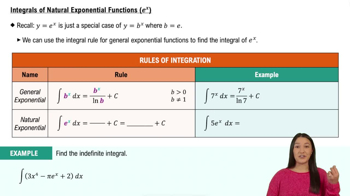
Integrals of Natural Exponential Functions (e^x)

Properties of the Natural Logarithm ln(x)

The natural logarithm has key properties such as ln(ab) = ln(a) + ln(b) and ln(a/b) = ln(a) - ln(b) for positive a and b. These properties help break down complex expressions into simpler parts, which is essential when manipulating expressions involving exp(x) through their logarithmic counterparts.
Video consigliato:
05:18
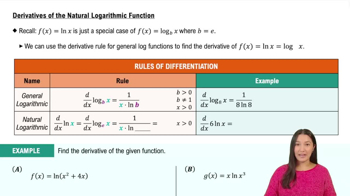
Derivative of the Natural Logarithmic Function

Exponential Function Laws

The exponential function satisfies laws similar to those of powers, including exp(x + y) = exp(x) * exp(y) and exp(0) = 1. Using these laws, one can rewrite expressions like exp(x - y) as exp(x) / exp(y), which is the property to be proven.
Video consigliato:
6:13
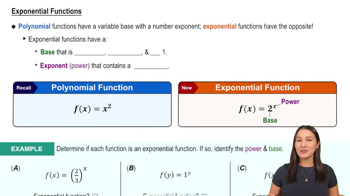
Exponential Functions
Pratica correlata
Domanda del libro di testo

Theorem 7.8

Differentiate sinh⁻¹ x = ln (x + √(x² + 1)) to show that d/dx (sinh⁻¹ x) = 1 / √(x² + 1).

79
views

Domanda del libro di testo

Overtaking City A has a current population of 500,000 people and grows at a rate of 3%/yr. City B has a current population of 300,000 and grows at a rate of 5%/yr.

b. Suppose City C has a current population of y₀ < 500,000 and a growth rate of p > 3%/yr. What is the relationship between y₀ and p such that Cities A and C have the same population in 10 years?

46
views
Domanda del libro di testo

Explain why or why not Determine whether the following statements are true and give an explanation or counterexample. Assume x > 0 and y > 0.


b. ln 0 = 1

93
views
Domanda del libro di testo

A running model A model for the startup of a runner in a short race results in the velocity function v(t) = a(1 - e⁻ᵗ/ᶜ), where a and c are positive constants, t is measured in seconds, and v has units of m/s. (Source: Joe Keller, A Theory of Competitive Running, Physics Today, 26, Sep 1973)


b. Using the velocity in part (a) and assuming s(0) = 0, find the position function s(t), for t ≥ 0.

57
views
Domanda del libro di testo

Projection sensitivity

According to the 2014 national population projections published by the U.S. Census Bureau, the U.S. population is projected to be 334.4 million in 2020 with an estimated growth rate of 0.79%/yr.

b. Suppose the actual growth rate is instead 0.7%. What are the resulting doubling time and projected 2050 population?

39
views
Domanda del libro di testo

"Integral formula Carry out the following steps to derive the formula ∫ csch x dx = ln |tanh(x / 2)| + C (Theorem 7.6).


b. Use the identity for sinh(2u) to show that 2 / sinh(2u) = sech² u / tanh u."

66
views