Ch. 7 - Logarithmic, Exponential Functions, and Hyperbolic Functions
Briggs - Calculus: Early Transcendentals 3rd Edition
Briggs3rd EditionCalculus: Early TranscendentalsISBN: 9780136847243Non è quello che usi tu?Cambia libro di testo
Capitolo 7, Problema 7.3.72

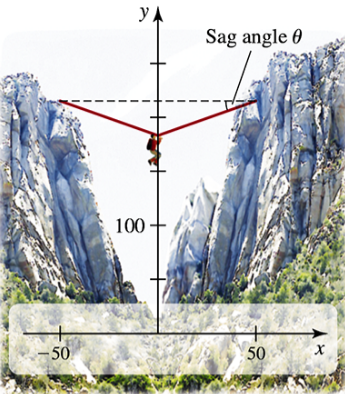
Sag angle Imagine a climber clipping onto the rope described in Example 7 and pulling himself to the rope’s midpoint. Because the rope is supporting the weight of the climber, it no longer takes the shape of the catenary y = 200 cosh x/200. Instead, the rope (nearly) forms two sides of an isosceles triangle. Compute the sag angle θ illustrated in the figure, assuming the rope does not stretch when weighted. Recall from Example 7 that the length of the rope is 101 ft.Climber hanging at rope midpoint between two cliffs forming an isosceles triangle with sag angle θ marked.

Guida verificata passo dopo passo
1
Identify the key elements of the problem: The rope forms two equal sides of an isosceles triangle with the climber at the midpoint, the horizontal distance between the two cliffs is 100 ft (from -50 to 50 on the x-axis), and the total length of the rope is 101 ft.
Since the rope forms two equal sides, each side of the rope has length \( \frac{101}{2} = 50.5 \) ft.
Use the right triangle formed by half the horizontal distance (50 ft), the vertical sag (unknown), and the rope length (50.5 ft) as the hypotenuse to find the sag angle \( \theta \).
Apply the cosine definition for the sag angle \( \theta \): \[ \cos \theta = \frac{\text{adjacent side}}{\text{hypotenuse}} = \frac{50}{50.5} \]
Solve for \( \theta \) by taking the inverse cosine (arccos) of the ratio: \[ \theta = \arccos \left( \frac{50}{50.5} \right) \]

Risposta video verificata per un problema simile:

Questa soluzione video è stata consigliata dai nostri tutor come utile per risolvere questo problema.
Durata del video:
4m

Concetti chiave

Ecco i concetti essenziali che devi comprendere per rispondere correttamente alla domanda.

Isosceles Triangle Geometry

An isosceles triangle has two sides of equal length and two equal angles opposite those sides. In this problem, the rope forms two equal segments from the midpoint to each cliff, creating an isosceles triangle. Understanding the properties of isosceles triangles helps relate the rope length and horizontal distance to the sag angle θ.
Video consigliato:
Percorso guidato
06:35
Changing Geometries

Trigonometric Relationships in Triangles

Trigonometry connects angles and side lengths in triangles using functions like sine, cosine, and tangent. To find the sag angle θ, one can use the cosine or sine function with known side lengths (half the horizontal distance and half the rope length). This allows calculation of θ from the triangle formed by the rope and the horizontal span.
Video consigliato:
Percorso guidato
6:04
Introduction to Trigonometric Functions

Arc Length and Rope Length Constraint

The rope length is fixed at 101 ft and does not stretch, so the total length equals the sum of the two equal rope segments. This constraint is essential to relate the rope length to the horizontal distance between cliffs and the vertical sag, enabling calculation of the sag angle θ by applying the triangle side length relationships.
Video consigliato:
Percorso guidato
06:29
Arc Length of Parametric Curves