Ch. 7 - Logarithmic, Exponential Functions, and Hyperbolic Functions
Briggs - Calculus: Early Transcendentals 3rd Edition
Briggs3rd EditionCalculus: Early TranscendentalsISBN: 9780136847243Non è quello che usi tu?Cambia libro di testo
Capitolo 7, Problema 7.2.20

15–20. Designing exponential growth functions Complete the following steps for the given situation.


a. Find the rate constant k and use it to devise an exponential growth function that fits the given data.
b. Answer the accompanying question.


Cell growth The number of cells in a tumor doubles every 6 weeks starting with 8 cells. After how many weeks does the tumor have 1500 cells?

Guida verificata passo dopo passo
1
Step 1: Identify the general form of the exponential growth function, which is given by \(N(t) = N_0 e^{k t}\), where \(N(t)\) is the number of cells at time \(t\), \(N_0\) is the initial number of cells, \(k\) is the growth rate constant, and \(t\) is the time in weeks.
Step 2: Use the information that the number of cells doubles every 6 weeks to find the rate constant \(k\). Since doubling means \(N(6) = 2 N_0\), substitute into the formula: \(2 N_0 = N_0 e^{k \times 6}\). Simplify this to \(2 = e^{6k}\).
Step 3: Solve for \(k\) by taking the natural logarithm of both sides: \(\ln(2) = 6k\), which gives \(k = \frac{\ln(2)}{6}\).
Step 4: Write the exponential growth function using the initial number of cells \(N_0 = 8\) and the rate constant \(k\): \(N(t) = 8 e^{\frac{\ln(2)}{6} t}\).
Step 5: To find the time \(t\) when the tumor has 1500 cells, set \(N(t) = 1500\) and solve for \(t\): \(1500 = 8 e^{\frac{\ln(2)}{6} t}\). Divide both sides by 8, then take the natural logarithm to isolate \(t\): \(\ln\left(\frac{1500}{8}\right) = \frac{\ln(2)}{6} t\), and finally solve for \(t\) by multiplying both sides by \(\frac{6}{\ln(2)}\).

Risposta video verificata per un problema simile:

Questa soluzione video è stata consigliata dai nostri tutor come utile per risolvere questo problema.
Durata del video:
3m

Concetti chiave

Ecco i concetti essenziali che devi comprendere per rispondere correttamente alla domanda.

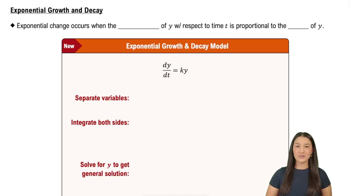
Exponential Growth Function

An exponential growth function models quantities that increase by a constant percentage rate over equal time intervals. It is generally expressed as N(t) = N_0 * e^(kt), where N_0 is the initial amount, k is the growth rate constant, and t is time. This function is essential for describing processes like cell growth where the quantity doubles periodically.
Video consigliato:
09:29
Exponential Growth & Decay

Rate Constant (k) in Exponential Growth

The rate constant k determines how quickly the quantity grows in an exponential model. It can be found using known data points and the formula k = (ln(final amount / initial amount)) / time. Calculating k allows us to create a precise growth function that fits the given data, such as doubling time in cell growth.
Video consigliato:
09:29
Exponential Growth & Decay

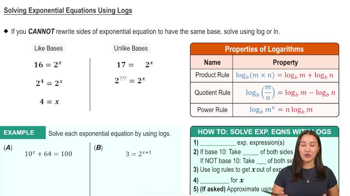
Solving for Time in Exponential Equations

To find the time when a quantity reaches a certain value, we solve the exponential equation for t. This involves isolating t by taking the natural logarithm of both sides and rearranging the formula. This step is crucial for answering questions like determining when the tumor reaches 1500 cells.
Video consigliato:
5:47
Solving Exponential Equations Using Logs