Ch. 8 - Integration Techniques
Briggs - Calculus: Early Transcendentals 3rd Edition
Briggs3rd EditionCalculus: Early TranscendentalsISBN: 9780136847243Non è quello che usi tu?Cambia libro di testo
Capitolo 8, Problema 8.R.119b

119. {Use of Tech} Comparing volumes Let R be the region bounded by y = ln(x), the x-axis, and the line x = a, where a > 1.
b. Find the volume V₂(a) of the solid generated when R is revolved about the y-axis (as a function of a).

Guida verificata passo dopo passo
1
First, identify the region R bounded by the curves: the graph of \(y = \ln(x)\), the x-axis (\(y=0\)), and the vertical line \(x = a\) where \(a > 1\). This region lies between \(x=1\) (since \(\ln(1) = 0\)) and \(x=a\) along the x-axis, and between \(y=0\) and \(y=\ln(a)\) along the y-axis.
Since the solid is generated by revolving the region R about the y-axis, consider using the method of cylindrical shells. The shell radius will be the distance from the y-axis, which is \(x\), and the shell height will be the vertical distance between the curves, which is \(\ln(x) - 0 = \ln(x)\).
The volume of the solid using the shell method is given by the integral formula: \(V_2(a) = \int_{x=1}^{a} 2\pi \cdot (\text{radius}) \cdot (\text{height}) \, dx = \int_{1}^{a} 2\pi x \ln(x) \, dx\).
Set up the integral explicitly: \(V_2(a) = 2\pi \int_{1}^{a} x \ln(x) \, dx\).
To evaluate the integral, use integration by parts where you let \(u = \ln(x)\) and \(dv = x \, dx\). Then compute \(du = \frac{1}{x} \, dx\) and \(v = \frac{x^2}{2}\). Apply the integration by parts formula: \(\int u \, dv = uv - \int v \, du\).

Risposta video verificata per un problema simile:

Questa soluzione video è stata consigliata dai nostri tutor come utile per risolvere questo problema.
Durata del video:
4m

Concetti chiave

Ecco i concetti essenziali che devi comprendere per rispondere correttamente alla domanda.

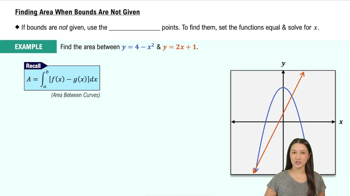
Region Bounded by Curves

Understanding the region R involves identifying the area enclosed by the curve y = ln(x), the x-axis (y = 0), and the vertical line x = a. This sets the limits for integration and defines the shape whose volume is to be found when revolved.
Video consigliato:
05:06
Finding Area When Bounds Are Not Given

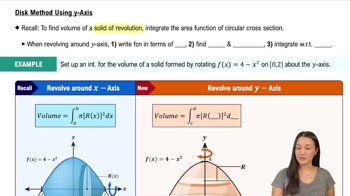
Volume of Solids of Revolution about the y-axis

To find the volume generated by revolving a region around the y-axis, methods like the shell method or the washer method are used. For this problem, the shell method is often preferred, integrating cylindrical shells with radius x and height given by the function.
Video consigliato:
06:30
Disk Method Using y-Axis

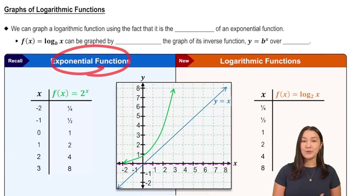
Integration with Logarithmic Functions

Calculating the volume requires integrating expressions involving ln(x). Familiarity with integration techniques for logarithmic functions, such as integration by parts, is essential to evaluate the integral and express the volume as a function of a.
Video consigliato:
5:26
Graphs of Logarithmic Functions
Pratica correlata
Domanda del libro di testo

2–74. Integration techniques Use the methods introduced in Sections 8.1 through 8.5 to evaluate the following integrals.

25. ∫ (from -3/2 to -1) dx/(4x² + 12x + 10)

56
views

Domanda del libro di testo

122. Comparing areas The region R₁ is bounded by the graph of y = tan(x) and the x-axis on the interval [0, π/3].

The region R₂ is bounded by the graph of y = sec(x) and the x-axis on the interval [0, π/6]. Which region has the greater area?

58
views
Domanda del libro di testo

95–98. {Use of Tech} Numerical integration Estimate the following integrals using the Midpoint Rule M(n), the Trapezoidal Rule T(n), and Simpson’s Rule S(n) for the given values of n.

96. ∫ (from 1 to 3) dx/(x³ + x + 1); n = 4

49
views
Domanda del libro di testo

118. Two worthy integrals

b. Let f be any positive continuous function on the interval [0, π/2]. Evaluate

∫ from 0 to π/2 of [f(cos x) / (f(cos x) + f(sin x))] dx.

(Hint: Use the identity cos(π/2 − x) = sin x.)


(Source: Mathematics Magazine 81, 2, Apr 2008)

125
views
Domanda del libro di testo

120. Equal volumes

a. Let R be the region bounded by the graph of f(x) = x^(-p) and the x-axis, for x ≥ 1. Let V₁ and V₂ be the volumes of the solids generated when R is revolved about the x-axis and the y-axis, respectively, if they exist. For what values of p (if any) is V₁ = V₂?

b. Repeat part (a) on the interval [0, 1].

75
views
Domanda del libro di testo

2–74. Integration techniques Use the methods introduced in Sections 8.1 through 8.5 to evaluate the following integrals.

57. ∫ (from 0 to √3/2) 4/(9 + 4x²) dx

54
views