

Ch. 8 - Integration Techniques
Briggs - Calculus: Early Transcendentals 3rd Edition
Briggs3rd EditionCalculus: Early TranscendentalsISBN: 9780136847243Non è quello che usi tu?Cambia libro di testo
Capitolo 8, Problema 8.R.25

2–74. Integration techniques Use the methods introduced in Sections 8.1 through 8.5 to evaluate the following integrals.
25. ∫ (from -3/2 to -1) dx/(4x² + 12x + 10)

Guida verificata passo dopo passo
1
Step 1: Recognize that the denominator of the integrand, 4x² + 12x + 10, is a quadratic expression. To simplify the integral, complete the square for the quadratic expression in the denominator.
Step 2: Rewrite 4x² + 12x + 10 by factoring out 4 from the first two terms: 4(x² + 3x) + 10. Then complete the square inside the parentheses: x² + 3x = (x + 3/2)² - (3/2)². Substitute this back into the expression.
Step 3: After completing the square, the denominator becomes 4((x + 3/2)² - 9/4) + 10. Simplify this expression to get 4(x + 3/2)² + 1.
Step 4: Recognize that the integral now has the form ∫ dx / [a² + (x - h)²], which is a standard form for integration using the arctangent function. Use the formula ∫ dx / (a² + x²) = (1/a) * arctan(x/a) + C, adjusting for the shift in x.
Step 5: Apply the limits of integration (-3/2 to -1) to the result obtained from the arctangent formula. Evaluate the definite integral by substituting the limits into the antiderivative.

Risposta video verificata per un problema simile:

Questa soluzione video è stata consigliata dai nostri tutor come utile per risolvere questo problema.
Durata del video:
5m

Concetti chiave

Ecco i concetti essenziali che devi comprendere per rispondere correttamente alla domanda.

Integration Techniques

Integration techniques are methods used to find the integral of a function. Common techniques include substitution, integration by parts, and partial fraction decomposition. Understanding these methods is essential for evaluating more complex integrals, especially those that cannot be solved using basic antiderivatives.
Video consigliato:
Percorso guidato
06:18
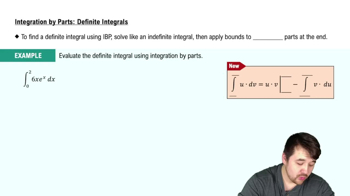
Integration by Parts for Definite Integrals

Definite Integrals

A definite integral calculates the area under a curve between two specified limits. It is represented as ∫ from a to b f(x) dx, where 'a' and 'b' are the bounds of integration. The result of a definite integral is a numerical value that represents this area, which is crucial for applications in physics and engineering.
Video consigliato:
Percorso guidato
05:43
Definition of the Definite Integral

Quadratic Functions

Quadratic functions are polynomial functions of the form ax² + bx + c, where a, b, and c are constants. In the context of integration, recognizing the structure of a quadratic expression can help in simplifying the integral, often by completing the square or using substitution to facilitate easier integration.
Video consigliato:
Percorso guidato
13:42
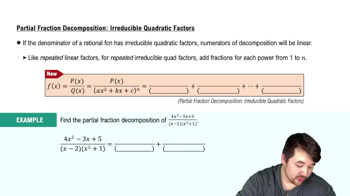
Partial Fraction Decomposition: Irreducible Quadratic Factors
Pratica correlata
Domanda del libro di testo

122. Comparing areas The region R₁ is bounded by the graph of y = tan(x) and the x-axis on the interval [0, π/3].

The region R₂ is bounded by the graph of y = sec(x) and the x-axis on the interval [0, π/6]. Which region has the greater area?

58
views
Domanda del libro di testo

82-88. Improper integrals Evaluate the following integrals or show that the integral diverges.

86. ∫ (from -∞ to ∞) x³/(1 + x⁸) dx

48
views
Domanda del libro di testo

95–98. {Use of Tech} Numerical integration Estimate the following integrals using the Midpoint Rule M(n), the Trapezoidal Rule T(n), and Simpson’s Rule S(n) for the given values of n.

96. ∫ (from 1 to 3) dx/(x³ + x + 1); n = 4

49
views
Domanda del libro di testo

120. Equal volumes

a. Let R be the region bounded by the graph of f(x) = x^(-p) and the x-axis, for x ≥ 1. Let V₁ and V₂ be the volumes of the solids generated when R is revolved about the x-axis and the y-axis, respectively, if they exist. For what values of p (if any) is V₁ = V₂?

b. Repeat part (a) on the interval [0, 1].

75
views
Domanda del libro di testo

119. {Use of Tech} Comparing volumes Let R be the region bounded by y = ln(x), the x-axis, and the line x = a, where a > 1.

b. Find the volume V₂(a) of the solid generated when R is revolved about the y-axis (as a function of a).

35
views
Domanda del libro di testo

2–74. Integration techniques Use the methods introduced in Sections 8.1 through 8.5 to evaluate the following integrals.

57. ∫ (from 0 to √3/2) 4/(9 + 4x²) dx

54
views