
Ch. 8 - Integration Techniques
Briggs - Calculus: Early Transcendentals 3rd Edition
Briggs3rd EditionCalculus: Early TranscendentalsISBN: 9780136847243Non è quello che usi tu?Cambia libro di testo
Capitolo 8, Problema 8.8.48c

45–48. {Use of Tech} Trapezoid Rule and Simpson’s Rule Consider the following integrals and the given values of n.
48. ∫(0 to π/4) (1/(1 + x²)) dx; n = 64
c. Compute the absolute errors in the Trapezoid Rule and Simpson’s Rule with 2n subintervals.

Guida verificata passo dopo passo
1
Step 1: Understand the problem. You are tasked with computing the absolute errors in the Trapezoid Rule and Simpson’s Rule for the integral ∫(0 to π/4) (1/(1 + x²)) dx using 2n subintervals, where n = 64. This means you will use 128 subintervals for the computation.
Step 2: Recall the formulas for the Trapezoid Rule and Simpson’s Rule. The Trapezoid Rule approximates the integral as a weighted sum of function values at evenly spaced points, while Simpson’s Rule uses a combination of parabolic approximations. Both methods depend on the number of subintervals and the step size.
Step 3: Compute the step size (h) for 2n subintervals. The step size is given by h = (b - a) / (2n), where a = 0, b = π/4, and n = 64. Substitute these values into the formula to find h.
Step 4: Apply the Trapezoid Rule and Simpson’s Rule formulas to approximate the integral. For the Trapezoid Rule, sum the function values at the endpoints and intermediate points, weighted appropriately. For Simpson’s Rule, use the alternating weights of 1, 4, and 2 for the function values at the subinterval points.
Step 5: Compute the absolute errors. The absolute error is the difference between the exact value of the integral and the approximations obtained using the Trapezoid Rule and Simpson’s Rule. To find the exact value of the integral, you may use a more precise numerical method or the analytical solution if available.

Risposta video verificata per un problema simile:

Questa soluzione video è stata consigliata dai nostri tutor come utile per risolvere questo problema.
Durata del video:
5m

Concetti chiave

Ecco i concetti essenziali che devi comprendere per rispondere correttamente alla domanda.

Trapezoid Rule

The Trapezoid Rule is a numerical method for approximating the definite integral of a function. It works by dividing the area under the curve into trapezoids rather than rectangles, providing a better approximation. The formula involves calculating the average of the function values at the endpoints of each subinterval and multiplying by the width of the subintervals. This method is particularly useful for functions that are continuous and smooth over the interval.
Video consigliato:
5:50
Power Rules

Simpson’s Rule

Simpson’s Rule is another numerical integration technique that provides a more accurate approximation than the Trapezoid Rule by using parabolic segments instead of straight lines. It requires an even number of subintervals and combines the function values at the endpoints and midpoints of the intervals. The formula is based on fitting a quadratic polynomial to the function over each pair of subintervals, which helps capture the curvature of the function more effectively.
Video consigliato:
5:50
Power Rules

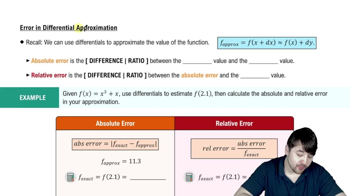
Absolute Error

Absolute error measures the difference between the exact value of an integral and the approximate value obtained using numerical methods like the Trapezoid Rule or Simpson’s Rule. It is calculated as the absolute value of the exact integral minus the approximate integral. Understanding absolute error is crucial for assessing the accuracy of numerical methods and determining how close the approximation is to the true value, which is particularly important when using a finite number of subintervals.
Video consigliato:
Percorso guidato
04:57
Determining Error and Relative Error
Pratica correlata
Domanda del libro di testo

43. A hot-air balloon is launched from an elevation of 5400 ft above sea level. As it rises, the vertical velocity is computed using a device (called a variometer) that measures the change in atmospheric pressure. The vertical velocities at selected times are shown in the table (with units of ft/min).

c. A polynomial that fits the data reasonably well is:

g(t) = 3.49t³ - 43.21t² + 142.43t - 1.75

Estimate the elevation of the balloon after five minutes using this polynomial.

74
views
Domanda del libro di testo

45–48. {Use of Tech} Trapezoid Rule and Simpson’s Rule Consider the following integrals and the given values of n.

45. ∫(0 to 1) e^(2x) dx; n = 25

c. Compute the absolute errors in the Trapezoid Rule and Simpson’s Rule with 2n subintervals.

67
views
Domanda del libro di testo

45–48. {Use of Tech} Trapezoid Rule and Simpson’s Rule Consider the following integrals and the given values of n.

47. ∫(1 to e) (1/x) dx; n = 50

c. Compute the absolute errors in the Trapezoid Rule and Simpson’s Rule with 2n subintervals.

62
views
Domanda del libro di testo

Computing areas On the interval [0,2], the graphs of f(x)=x²/3 and g(x)=x²(9−x²)^(-1/2) have similar shapes.

c. Which region has greater area?

64
views
Domanda del libro di testo

60. Two Methods

c. Verify that your answers to parts (a) and (b) are consistent.

37
views
Domanda del libro di testo

75. {Use of Tech} Oscillator displacements Suppose a mass on a spring that is slowed by friction has the position function:

s(t) = e⁻ᵗ sin t

c. Generalize part (b) and find the average value of the position on the interval [nπ, (n+1)π], for n = 0, 1, 2, ...

35
views