Ch. 8 - Integration Techniques
Briggs - Calculus: Early Transcendentals 3rd Edition
Briggs3rd EditionCalculus: Early TranscendentalsISBN: 9780136847243Non è quello che usi tu?Cambia libro di testo
Capitolo 8, Problema 8.4.78c

Computing areas On the interval [0,2], the graphs of f(x)=x²/3 and g(x)=x²(9−x²)^(-1/2) have similar shapes.
c. Which region has greater area?

Guida verificata passo dopo passo
1
First, identify the two functions given: \(f(x) = \frac{x^{2}}{3}\) and \(g(x) = \frac{x^{2}}{\sqrt{9 - x^{2}}}\), both defined on the interval \([0, 2]\).
To compare the areas under the curves of \(f(x)\) and \(g(x)\) on \([0, 2]\), set up the definite integrals for each function: \(A_f = \int_0^2 \frac{x^{2}}{3} \, dx\) and \(A_g = \int_0^2 \frac{x^{2}}{\sqrt{9 - x^{2}}} \, dx\).
Evaluate each integral separately by applying appropriate integration techniques: for \(A_f\), use the power rule for integration; for \(A_g\), consider a trigonometric substitution such as \(x = 3 \sin \theta\) to simplify the integral.
After finding the expressions for both \(A_f\) and \(A_g\), compare their values to determine which area is greater.
Conclude which region has the greater area based on the comparison of the two definite integrals.

Risposta video verificata per un problema simile:

Questa soluzione video è stata consigliata dai nostri tutor come utile per risolvere questo problema.
Durata del video:
9m

Concetti chiave

Ecco i concetti essenziali che devi comprendere per rispondere correttamente alla domanda.

Definite Integral as Area Under a Curve

The definite integral of a function over an interval represents the net area between the graph of the function and the x-axis. To find the area of a region bounded by a curve and the x-axis, we compute the integral of the function over the given interval.
Video consigliato:
Percorso guidato
05:43
Definition of the Definite Integral

Comparing Areas of Two Functions

To determine which region has a greater area between two functions on the same interval, calculate the definite integrals of each function separately over that interval. The function with the larger integral value corresponds to the region with the greater area.
Video consigliato:
05:06
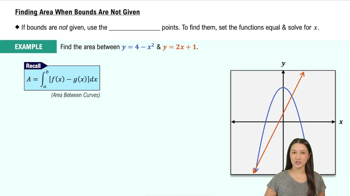
Finding Area When Bounds Are Not Given

Handling Functions with Domain Restrictions

When dealing with functions like g(x) = x²(9−x²)^(-1/2), it is important to consider the domain where the function is defined and real-valued. Ensuring the function is integrable on the interval [0,2] is essential before computing the area.
Video consigliato:
Percorso guidato
5:10
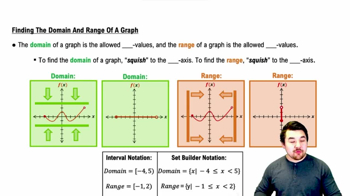
Finding the Domain and Range of a Graph
Pratica correlata
Domanda del libro di testo

45–48. {Use of Tech} Trapezoid Rule and Simpson’s Rule Consider the following integrals and the given values of n.

48. ∫(0 to π/4) (1/(1 + x²)) dx; n = 64

c. Compute the absolute errors in the Trapezoid Rule and Simpson’s Rule with 2n subintervals.

68
views
Domanda del libro di testo

109. Escape velocity and black holes The work required to launch an object from the surface of Earth to outer space is given by W = ∫ from R to ∞ of F(x) dx, where R = 6370 km is the approximate radius of Earth, F(x) = (GMm)/x² is the gravitational force between Earth and the object, G is the gravitational constant, M is the mass of Earth, m is the mass of the object, and GM = 4 × 10¹⁴ m³/s².

c. The French scientist Laplace anticipated the existence of black holes in the 18th century with the following argument: If a body has an escape velocity that equals or exceeds the speed of light, c = 300,000 km/s, then light cannot escape the body and it cannot be seen. Show that such a body has a radius R ≤ 2GM/c². For Earth to be a black hole, what would its radius need to be?

53
views
Domanda del libro di testo

43. A hot-air balloon is launched from an elevation of 5400 ft above sea level. As it rises, the vertical velocity is computed using a device (called a variometer) that measures the change in atmospheric pressure. The vertical velocities at selected times are shown in the table (with units of ft/min).

c. A polynomial that fits the data reasonably well is:

g(t) = 3.49t³ - 43.21t² + 142.43t - 1.75

Estimate the elevation of the balloon after five minutes using this polynomial.

74
views
Domanda del libro di testo

45–48. {Use of Tech} Trapezoid Rule and Simpson’s Rule Consider the following integrals and the given values of n.

47. ∫(1 to e) (1/x) dx; n = 50

c. Compute the absolute errors in the Trapezoid Rule and Simpson’s Rule with 2n subintervals.

62
views
Domanda del libro di testo

75. {Use of Tech} Oscillator displacements Suppose a mass on a spring that is slowed by friction has the position function:

s(t) = e⁻ᵗ sin t

c. Generalize part (b) and find the average value of the position on the interval [nπ, (n+1)π], for n = 0, 1, 2, ...

35
views
Domanda del libro di testo

91. [Use of Tech] Regions bounded by exponentials Let a > 0 and let R be the region bounded by the graph of y = e^(-a·x) and the x-axis

on the interval [b, ∞).

c. Find the minimum value b* such that when b > b*, there exists some a > 0 where A(a,b) = 2.

36
views