Ch. 8 - Integration Techniques
Briggs - Calculus: Early Transcendentals 3rd Edition
Briggs3rd EditionCalculus: Early TranscendentalsISBN: 9780136847243Non è quello che usi tu?Cambia libro di testo
Capitolo 8, Problema 8.4.57d

57. Explain why or why not Determine whether the following statements are true and give an explanation or counterexample.
d. The integral ∫ dx/(x² + 4x + 9) cannot be evaluated using a trigonometric substitution.

Guida verificata passo dopo passo
1
Start by examining the integral \( \int \frac{dx}{x^2 + 4x + 9} \). Notice that the denominator is a quadratic expression that can be completed to a perfect square form plus a constant.
Complete the square for the quadratic in the denominator: \( x^2 + 4x + 9 = (x^2 + 4x + 4) + 5 = (x + 2)^2 + 5 \). This transforms the integral into \( \int \frac{dx}{(x + 2)^2 + 5} \).
Recognize that the integral now resembles the standard form \( \int \frac{dx}{x^2 + a^2} = \frac{1}{a} \arctan\left(\frac{x}{a}\right) + C \), where \( a^2 = 5 \). This suggests a direct substitution rather than a trigonometric substitution is more straightforward.
Understand that trigonometric substitution is typically used when the integrand involves expressions like \( \sqrt{a^2 - x^2} \), \( \sqrt{a^2 + x^2} \), or \( \sqrt{x^2 - a^2} \). Since the denominator here is a sum of squares without a square root, trigonometric substitution is not necessary.
Conclude that the integral can be evaluated using a simple substitution and the arctangent formula, so the statement that it cannot be evaluated using trigonometric substitution is true in the sense that trigonometric substitution is not the appropriate or needed method here.

Risposta video verificata per un problema simile:

Questa soluzione video è stata consigliata dai nostri tutor come utile per risolvere questo problema.
Durata del video:
2m

Concetti chiave

Ecco i concetti essenziali che devi comprendere per rispondere correttamente alla domanda.

Trigonometric Substitution

Trigonometric substitution is a technique used to evaluate integrals involving expressions like √(a² - x²), √(a² + x²), or √(x² - a²). It replaces algebraic expressions with trigonometric functions to simplify the integral. This method is most effective when the integrand contains a quadratic expression under a square root.
Video consigliato:
Percorso guidato
6:04
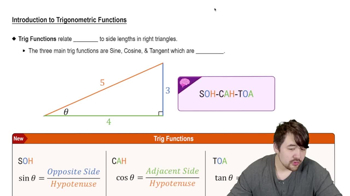
Introduction to Trigonometric Functions

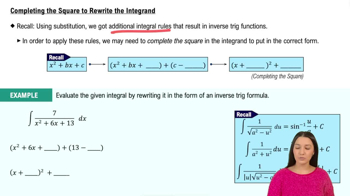
Completing the Square

Completing the square transforms a quadratic expression into the form (x + h)² + k, which simplifies integration. This technique helps identify the structure of the quadratic, making it easier to apply substitution methods or recognize standard integral forms. For example, x² + 4x + 9 can be rewritten as (x + 2)² + 5.
Video consigliato:
05:22
Completing the Square to Rewrite the Integrand

Integration of Rational Functions with Quadratic Denominators

Integrals of the form ∫ dx/(quadratic) often use methods like completing the square and recognizing standard integral formulas involving arctangent functions. When the quadratic has no real roots, the integral can be expressed in terms of inverse trigonometric functions without necessarily requiring trigonometric substitution.
Video consigliato:
06:11
Limits of Rational Functions: Denominator = 0