Ch. 8 - Integration Techniques
Briggs - Calculus: Early Transcendentals 3rd Edition
Briggs3rd EditionCalculus: Early TranscendentalsISBN: 9780136847243Non è quello che usi tu?Cambia libro di testo
Capitolo 8, Problema 8.9.87d

87. Explain why or why not Determine whether the following statements are true and give an explanation or counterexample.
d. If ∫(from 1 to ∞) x^(-p) dx exists, then ∫(from 1 to ∞) x^(-q) dx exists (where q > p).

Guida verificata passo dopo passo
1
Recall the integral in question is an improper integral of the form \(\int_1^{\infty} x^{-p} \, dx\). The convergence of this integral depends on the value of the exponent \(p\).
Determine the condition for convergence of \(\int_1^{\infty} x^{-p} \, dx\). This integral converges if and only if \(p > 1\). This is because the antiderivative is \(\frac{x^{-p+1}}{-p+1}\), and the limit as \(x \to \infty\) exists only when \(-p + 1 < 0\), or equivalently \(p > 1\).
Given that \(\int_1^{\infty} x^{-p} \, dx\) exists (converges), we know \(p > 1\). Now consider \(q > p\). Since \(q\) is greater than \(p\) and \(p > 1\), it follows that \(q > 1\) as well.
Because \(q > 1\), the integral \(\int_1^{\infty} x^{-q} \, dx\) also converges by the same reasoning as for \(p\). Thus, if the integral converges for \(p\), it must also converge for any \(q > p\).
Therefore, the statement is true: if \(\int_1^{\infty} x^{-p} \, dx\) exists, then \(\int_1^{\infty} x^{-q} \, dx\) exists for all \(q > p\).

Risposta video verificata per un problema simile:

Questa soluzione video è stata consigliata dai nostri tutor come utile per risolvere questo problema.
Durata del video:
1m

Concetti chiave

Ecco i concetti essenziali che devi comprendere per rispondere correttamente alla domanda.

Improper Integrals and Convergence

Improper integrals extend the concept of definite integrals to infinite intervals or unbounded functions. Convergence means the integral approaches a finite value as the limit approaches infinity. Determining convergence often involves comparing the integrand's behavior at infinity.
Video consigliato:
Percorso guidato
11:11
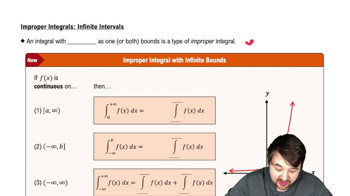
Improper Integrals: Infinite Intervals

p-Series Integral Test

The integral ∫₁^∞ x^(-p) dx converges if and only if p > 1. This is a fundamental result used to test convergence of integrals and series with power functions. It helps determine whether the area under the curve is finite over an infinite interval.
Video consigliato:
Percorso guidato
04:30
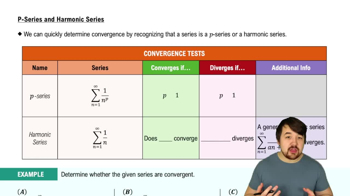
P-Series and Harmonic Series

Comparison of Exponents in Power Functions

For power functions x^(-p), a larger exponent p means the function decreases faster as x → ∞. If the integral converges for some p, it will also converge for any q > p because x^(-q) decays faster, ensuring the integral's convergence.
Video consigliato:
7:39
Introduction to Exponent Rules
Pratica correlata
Domanda del libro di testo

81. Possible and impossible integrals

Let Iₙ = ∫ xⁿ e⁻ˣ² dx, where n is a nonnegative integer.

d. Show that, in general, if n is odd, then Iₙ = -½ e⁻ˣ² pₙ₋₁(x), where pₙ₋₁ is a polynomial of degree n - 1.

66
views

Domanda del libro di testo

57. Explain why or why not Determine whether the following statements are true and give an explanation or counterexample.

d. The integral ∫ dx/(x² + 4x + 9) cannot be evaluated using a trigonometric substitution.

43
views
Domanda del libro di testo

93. Three start-ups Three cars, A, B, and C, start from rest and accelerate along a line according to the following velocity functions:

vₐ(t) = 88t/(t + 1), v_B(t) = 88t²/(t + 1)², and v_C(t) = 88t²/(t² + 1).

d. Which car ultimately gains the lead and remains in front?

42
views
Domanda del libro di testo

66–71. {Use of Tech} Estimating error Refer to Theorem 8.1 in the following exercises.

68. Let f(x) = e^(x²).

d. Use Theorem 8.1 to find an upper bound on the absolute error in the estimate found in part (a).

43
views
Domanda del libro di testo

77. Tabular integration Consider the integral ∫ f(x)g(x) dx, where f can be differentiated repeatedly and g can be integrated repeatedly

Let Gₖ represent the result of calculating k indefinite integrals of g (omitting constants of integration).

d. The tabular integration table from part (c) is easily extended to allow for as many steps as necessary in the process of integration by parts.

Evaluate ∫ x² e^(x/2) dx by constructing an appropriate table, and explain why the process terminates after four rows of the table have been filled in.

78
views
Domanda del libro di testo

82. A family of exponentials The curves y = x * e^(-a * x) are shown in the figure for a = 1, 2, and 3.


e. Does this pattern continue? Is it true that A(1, ln b) = a² * A(a, (ln b)/a)?

42
views