Ch. 8 - Integration Techniques
Briggs - Calculus: Early Transcendentals 3rd Edition
Briggs3rd EditionCalculus: Early TranscendentalsISBN: 9780136847243Non è quello che usi tu?Cambia libro di testo
Capitolo 8, Problema 8.4.54

7-56. Trigonometric substitutions Evaluate the following integrals using trigonometric substitution.
54. ∫ y⁴/(1 + y²) dy

Guida verificata passo dopo passo
1
Step 1: Recognize that the integral ∫ y⁴/(1 + y²) dy involves a rational function with a quadratic term in the denominator. This suggests that trigonometric substitution might simplify the integral. Specifically, use the substitution y = tan(θ), which implies dy = sec²(θ) dθ and 1 + y² = sec²(θ).
Step 2: Substitute y = tan(θ) into the integral. Replace y⁴ with (tan(θ))⁴, 1 + y² with sec²(θ), and dy with sec²(θ) dθ. The integral becomes ∫ (tan⁴(θ) / sec²(θ)) sec²(θ) dθ, which simplifies to ∫ tan⁴(θ) dθ.
Step 3: Simplify the integral further by expressing tan⁴(θ) in terms of lower powers of tan(θ). Use the identity tan²(θ) = sec²(θ) - 1 to rewrite tan⁴(θ) as (tan²(θ))² = (sec²(θ) - 1)². Expand this expression to get tan⁴(θ) = sec⁴(θ) - 2sec²(θ) + 1.
Step 4: Break the integral ∫ tan⁴(θ) dθ into separate integrals using the expanded form: ∫ tan⁴(θ) dθ = ∫ (sec⁴(θ) - 2sec²(θ) + 1) dθ. Evaluate each term separately: ∫ sec⁴(θ) dθ, ∫ sec²(θ) dθ, and ∫ 1 dθ. Recall that ∫ sec²(θ) dθ = tan(θ) and ∫ 1 dθ = θ. For ∫ sec⁴(θ) dθ, use reduction formulas or known results.
Step 5: After evaluating the integral in terms of θ, revert back to the original variable y using the substitution y = tan(θ). Use the relationship tan(θ) = y and θ = arctan(y) to express the final result in terms of y.

Risposta video verificata per un problema simile:

Questa soluzione video è stata consigliata dai nostri tutor come utile per risolvere questo problema.
Durata del video:
7m

Concetti chiave

Ecco i concetti essenziali che devi comprendere per rispondere correttamente alla domanda.

Trigonometric Substitution

Trigonometric substitution is a technique used in calculus to simplify integrals involving algebraic expressions. By substituting a variable with a trigonometric function, such as y = tan(θ) or y = sin(θ), the integral can often be transformed into a more manageable form. This method is particularly useful for integrals that include square roots or rational functions, allowing for easier integration.
Video consigliato:
Percorso guidato
6:04
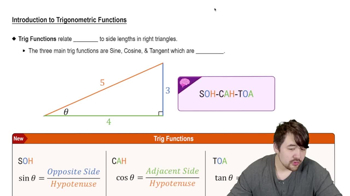
Introduction to Trigonometric Functions

Integral of Rational Functions

Integrating rational functions involves finding the antiderivative of a function that is the ratio of two polynomials. In the case of the integral ∫ y⁴/(1 + y²) dy, recognizing the structure of the rational function is crucial. Techniques such as polynomial long division or partial fraction decomposition may be employed, but trigonometric substitution can also simplify the process by transforming the integral into a trigonometric form.
Video consigliato:
6:04
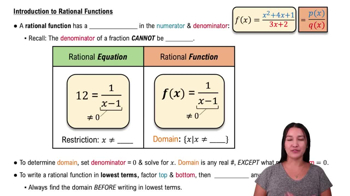
Intro to Rational Functions

Differentiation of Trigonometric Functions

Understanding the derivatives of trigonometric functions is essential when performing trigonometric substitution. For example, if y = tan(θ), then dy = sec²(θ) dθ. This relationship is vital for converting the integral back into terms of θ after substitution. Familiarity with these derivatives ensures that the integration process remains accurate and efficient, allowing for the correct evaluation of the integral.
Video consigliato:
Percorso guidato
6:04
Introduction to Trigonometric Functions