
Domanda del libro di testo
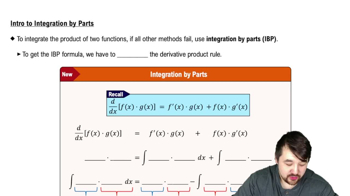
9–40. Integration by parts Evaluate the following integrals using integration by parts.
26. ∫ t³ sin(t) dt
42
views

 Guida verificata passo dopo passo
 08:30
08:30
 07:51
07:51 05:11
05:119–40. Integration by parts Evaluate the following integrals using integration by parts.
26. ∫ t³ sin(t) dt
7–64. Integration review Evaluate the following integrals.
57. ∫ dx / (x¹⸍² + x³⸍²)
90. Work Let R be the region in the first quadrant bounded by the curve y = √(x⁴ - 4)
and the lines y = 0 and y = 2. Suppose a tank that is full of water has the shape of a solid of revolution obtained by revolving region R about the y-axis. How much work is required to pump all the water to the top of the tank? Assume x and y are in meters.
76. Apparent discrepancy
Three different computer algebra systems give the following results:
∫ (dx / (x√(x⁴ − 1))) = ½ cos⁻¹(√(x⁻⁴)) = ½ cos⁻¹(x⁻²) = ½ tan⁻¹(√(x⁴ − 1)).
Explain how all three can be correct.
7-56. Trigonometric substitutions Evaluate the following integrals using trigonometric substitution.
54. ∫ y⁴/(1 + y²) dy
9–40. Integration by parts Evaluate the following integrals using integration by parts.
36. ∫ from 0 to ln2 x eˣ dx