
Ch. 8 - Integration Techniques
Briggs - Calculus: Early Transcendentals 3rd Edition
Briggs3rd EditionCalculus: Early TranscendentalsISBN: 9780136847243Non è quello che usi tu?Cambia libro di testo
Capitolo 8, Problema 8.9.50

7–58. Improper integrals Evaluate the following integrals or state that they diverge.
50. ∫ (from 0 to 9) 1/(x - 1)¹ᐟ³ dx

Guida verificata passo dopo passo
1
Identify the type of integral and check for any points of discontinuity or singularities within the interval of integration. Here, the integrand is \(\frac{1}{(x - 1)^{1/3}}\), and the interval is from 0 to 9. Notice that the function is undefined at \(x = 1\) because the denominator becomes zero there.
Since \(x = 1\) lies within the interval of integration, split the integral at this point to handle the improper integral properly. Write the integral as the sum of two integrals: \(\int_0^1 \frac{1}{(x - 1)^{1/3}} \, dx + \int_1^9 \frac{1}{(x - 1)^{1/3}} \, dx\).
Rewrite each integral as a limit approaching the point of discontinuity. For the first integral, express it as \(\lim_{t \to 1^-} \int_0^t \frac{1}{(x - 1)^{1/3}} \, dx\). For the second integral, express it as \(\lim_{s \to 1^+} \int_s^9 \frac{1}{(x - 1)^{1/3}} \, dx\).
Find the antiderivative of the integrand \(\frac{1}{(x - 1)^{1/3}}\). Recall that \(\int (x - a)^n \, dx = \frac{(x - a)^{n+1}}{n+1} + C\) for \(n \neq -1\). Here, \(n = -\frac{1}{3}\), so the antiderivative is \(\frac{(x - 1)^{2/3}}{\frac{2}{3}} + C = \frac{3}{2} (x - 1)^{2/3} + C\).
Evaluate each limit by substituting the antiderivative back into the definite integrals and taking the limits as \(t \to 1^-\) and \(s \to 1^+\). Determine whether these limits converge to finite values or diverge to infinity to conclude if the original integral converges or diverges.

Risposta video verificata per un problema simile:

Questa soluzione video è stata consigliata dai nostri tutor come utile per risolvere questo problema.
Durata del video:
4m

Concetti chiave

Ecco i concetti essenziali che devi comprendere per rispondere correttamente alla domanda.

Improper Integrals

Improper integrals involve integrals with infinite limits or integrands with discontinuities within the interval. To evaluate them, one must consider limits approaching the problematic points to determine convergence or divergence.
Video consigliato:
Percorso guidato
11:11
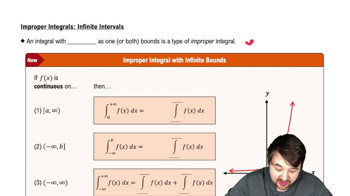
Improper Integrals: Infinite Intervals

Integrals with Discontinuous Integrands

When the integrand has a discontinuity inside the integration interval, the integral is split at the discontinuity point. Each part is evaluated as a limit approaching the discontinuity to check if the integral converges.
Video consigliato:
05:22
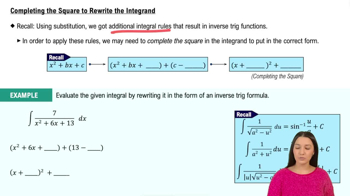
Completing the Square to Rewrite the Integrand

Behavior of Functions Near Singularities

Understanding how functions behave near points where they become unbounded or undefined is crucial. For example, functions like 1/(x - a)^p converge near x = a if p < 1, and diverge if p ≥ 1, guiding the evaluation of improper integrals.
Video consigliato:
5:46
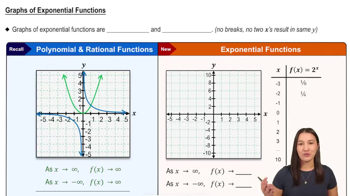
Graphs of Exponential Functions