
Ch. 8 - Integration Techniques
Briggs - Calculus: Early Transcendentals 3rd Edition
Briggs3rd EditionCalculus: Early TranscendentalsISBN: 9780136847243Non è quello che usi tu?Cambia libro di testo
Capitolo 8, Problema 8.6.25

7–84. Evaluate the following integrals.
25. ∫ [1 / (x√(1 - x²))] dx

Guida verificata passo dopo passo
1
Step 1: Recognize the integral's structure. The given integral is ∫ [1 / (x√(1 - x²))] dx. Notice that it involves a square root and a fraction, which suggests it may be related to trigonometric substitution or a known derivative formula.
Step 2: Recall the derivative of the inverse secant function. The derivative of sec⁻¹(x) is 1 / (x√(x² - 1)). Compare this with the given integral and observe that the denominator here is √(1 - x²), not √(x² - 1). This suggests a different approach.
Step 3: Consider substitution. To simplify the integral, let x = sin(θ). This substitution works because √(1 - x²) becomes √(1 - sin²(θ)), which simplifies to cos(θ). Also, dx = cos(θ)dθ.
Step 4: Rewrite the integral using the substitution. Substituting x = sin(θ) and dx = cos(θ)dθ, the integral becomes ∫ [1 / (sin(θ)cos(θ))] cos(θ)dθ. Simplify the expression to ∫ [1 / sin(θ)] dθ.
Step 5: Solve the simplified integral. The integral ∫ [1 / sin(θ)] dθ can be rewritten as ∫ csc(θ) dθ. Use the known formula for the integral of csc(θ), which is -ln|csc(θ) + cot(θ)| + C. Finally, revert back to the original variable x using the substitution x = sin(θ).

Risposta video verificata per un problema simile:

Questa soluzione video è stata consigliata dai nostri tutor come utile per risolvere questo problema.
Durata del video:
7m

Concetti chiave

Ecco i concetti essenziali che devi comprendere per rispondere correttamente alla domanda.

Integration

Integration is a fundamental concept in calculus that involves finding the accumulated area under a curve represented by a function. It is the reverse process of differentiation and is used to calculate quantities such as areas, volumes, and total accumulated change. The integral can be definite, providing a numerical value over a specific interval, or indefinite, resulting in a general form of antiderivatives.
Video consigliato:
Percorso guidato
06:18
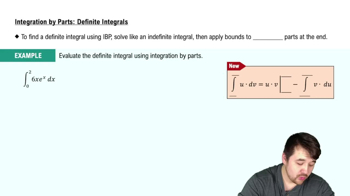
Integration by Parts for Definite Integrals

Substitution Method

The substitution method is a technique used in integration to simplify the process by changing the variable of integration. By substituting a part of the integrand with a new variable, the integral can often be transformed into a more manageable form. This method is particularly useful when dealing with composite functions or when the integrand contains a function and its derivative.
Video consigliato:
07:33
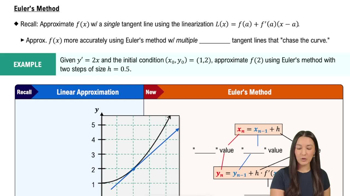
Euler's Method

Trigonometric Substitution

Trigonometric substitution is a specific technique used in integration to simplify integrals involving square roots of quadratic expressions. By substituting variables with trigonometric functions, such as sine or cosine, the integral can be transformed into a form that is easier to evaluate. This method is especially effective for integrals that include expressions like √(1 - x²) or √(x² - 1).
Video consigliato:
Percorso guidato
6:04
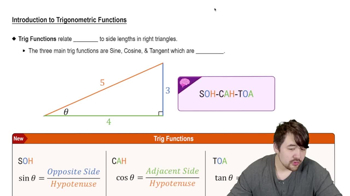
Introduction to Trigonometric Functions
Pratica correlata
Domanda del libro di testo

108. Draining a tank Water is drained from a 3000-gal tank at a rate that starts at 100 gal/hr and decreases continuously by 5%/hr. If the drain is left open indefinitely, how much water drains from the tank? Can a full tank be emptied at this rate? 

38
views
Domanda del libro di testo

76–83. Preliminary steps The following integrals require a preliminary step such as a change of variables before using the method of partial fractions. Evaluate these integrals.

76. ∫ [cosθ / (sin³θ - 4sinθ)] dθ

44
views
Domanda del libro di testo

64. (Use of Tech) Normal distribution of movie lengths

A study revealed that the lengths of U.S. movies are normally distributed with a mean of 110 minutes and a standard deviation of 22 minutes. This means that the fraction of movies with lengths between a and b minutes (with a < b) is given by the integral:

(1/(22√(2π))) ∫[a to b] e^(-((x-110)/22)²/2) dx.

What percentage of U.S. movies are between 1 hr and 1.5 hr long (60-90 min)?

73
views
Domanda del libro di testo

9–40. Integration by parts Evaluate the following integrals using integration by parts.

40. ∫ e^√x dx

48
views
Domanda del libro di testo

7–58. Improper integrals Evaluate the following integrals or state that they diverge.

50. ∫ (from 0 to 9) 1/(x - 1)¹ᐟ³ dx

71
views
Domanda del libro di testo

74. A secant reduction formula

Prove that for positive integers n ≠ 1,

∫ secⁿ x dx = (secⁿ⁻² x tan x)/(n − 1) + (n − 2)/(n − 1) ∫ secⁿ⁻² x dx.

(Hint: Integrate by parts with u = secⁿ⁻² x and dv = sec² x dx.)

70
views