Ch. 8 - Integration Techniques
Briggs - Calculus: Early Transcendentals 3rd Edition
Briggs3rd EditionCalculus: Early TranscendentalsISBN: 9780136847243Non è quello che usi tu?Cambia libro di testo
Capitolo 8, Problema 8.2.77d

77. Tabular integration Consider the integral ∫ f(x)g(x) dx, where f can be differentiated repeatedly and g can be integrated repeatedly
Let Gₖ represent the result of calculating k indefinite integrals of g (omitting constants of integration).
d. The tabular integration table from part (c) is easily extended to allow for as many steps as necessary in the process of integration by parts.
Evaluate ∫ x² e^(x/2) dx by constructing an appropriate table, and explain why the process terminates after four rows of the table have been filled in.

Guida verificata passo dopo passo
1
Identify the functions for integration by parts: let \( f(x) = x^2 \) (which can be differentiated repeatedly) and \( g(x) = e^{x/2} \) (which can be integrated repeatedly).
Construct a table with two columns: one for successive derivatives of \( f(x) \) and one for successive integrals of \( g(x) \). Start by listing \( f(x) \) and its derivatives down the left column, and \( g(x) \) and its integrals down the right column.
Calculate the derivatives of \( f(x) = x^2 \): \( f'(x) = 2x \), \( f''(x) = 2 \), and \( f'''(x) = 0 \). This shows the differentiation process will terminate after the third derivative because the derivative becomes zero.
Calculate the integrals of \( g(x) = e^{x/2} \): the first integral is \( G_1 = \int e^{x/2} dx \), the second integral \( G_2 = \int G_1 dx \), and so on, each time integrating the previous result.
Use the tabular integration method by multiplying diagonally and alternating signs (+, -, +, -) to write the sum of products of derivatives of \( f \) and integrals of \( g \). The process terminates after four rows because the derivative of \( f \) becomes zero, so no further terms contribute to the integral.

Risposta video verificata per un problema simile:

Questa soluzione video è stata consigliata dai nostri tutor come utile per risolvere questo problema.
Durata del video:
4m

Concetti chiave

Ecco i concetti essenziali che devi comprendere per rispondere correttamente alla domanda.

Integration by Parts

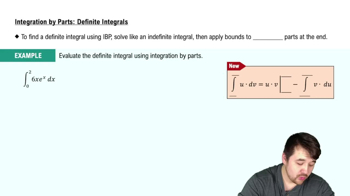
Integration by parts is a technique derived from the product rule of differentiation. It transforms the integral of a product of functions into simpler integrals, using the formula ∫u dv = uv - ∫v du. Choosing u and dv wisely simplifies the problem, especially when one function becomes simpler upon differentiation.
Video consigliato:
Percorso guidato
06:18
Integration by Parts for Definite Integrals

Tabular Integration Method

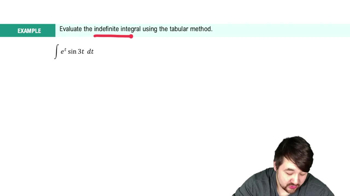
Tabular integration is a streamlined approach to repeated integration by parts. It organizes derivatives of one function and integrals of the other in a table, alternating signs to quickly sum terms. This method is efficient when one function differentiates to zero after finite steps, allowing the process to terminate naturally.
Video consigliato:
Percorso guidato
09:15
Tabular Integration by Parts Example 6

Termination of the Integration Process

The integration process terminates when repeated differentiation of one function results in zero, eliminating further terms. In the example ∫ x² e^(x/2) dx, differentiating x² repeatedly leads to zero after the third derivative, so the tabular method ends after four rows, ensuring a finite and complete solution.
Video consigliato:
Percorso guidato
06:18
Integration by Parts for Definite Integrals